Artist interview: Dawn Tan

I met the bubbly watercolour artist Dawn Tan when I was in Melbourne, and what a thrill it was! As a full-time artist with a part-time job teaching children art, she hails from Singapore but now calls Melbourne home. She’s a sweetheart for meeting with me on short notice (it was Chinese New Year eve) and we hit it off instantly! Read on to know more on how she started her teaching career as a gutsy 16 year old, and how her conversations with her mother resulted in the scrumptious watercolour food paintings that she’s well known for. You can follow her on Instagram (where I guarantee you’ll turn green with envy at her adventures!), and do check out her website for more of her in-person workshops and classes.

dawn_tan


I was swooning over the pictures you took on your recent trip to New York! How was it?

I wish I was still there!

Right from the start, my husband Darren and I knew we wanted to go to New York for our honeymoon. We were even more sure of our honeymoon destination than the wedding venue itself! We wanted to go there for the artists, the makers, the studios and shops. Funnily enough though, we didn’t see enough small shops. We couldn’t find them over there because the place is so big! Unlike over here where the good stuff is clustered along streets (like Gertrude street), theirs is really spaced out and far in between. A lot of locals mentioned there wasn’t a street or neighbourhood that has a centralised indie shopping street. But we did managed to go to a few studios at Dobbin Mews like Odette (and I bought a few pieces!) and also MCMC Fragrances. I followed Jennifer of Odette on Instagram and it was great to see her studio to chat with her! I love her work, and have been a fan for many years.

I also managed to meet up with Helen Dealtry – I bought a scarf and had a great time talking to her. We both run workshops and we were talking about the business side of it. It was so much fun!

Screenshot 2015-04-06 22.20.49

How did you and Darren meet?

Darren came to Melbourne before I did. He completed his studies here and then he started working. We met at a pre-departure briefing at university; he was a senior and he was giving out advice to juniors who were about to go to Melbourne for studies. He was also my neighbour at my student accommodation and that’s we got close. We started cooking together and that’s how we fell in love! It’s now 7 years since!

Was there a reason you decided to stay on in Melbourne?

I didn’t plan to stay! I’ve always thought of studying for 3 years and then head back to Singapore. But before graduating I decided I really liked it here. I love the culture, the lifestyle, and I felt that it would be a  great place to raise kids. The school here has a lot more emphasis on play-based learning, while Asian schools are more geared towards rote-learning, like math and science. And while this may have changed over the years, I like the fact that in Melbourne the school system places emphasis on other subjects like sports, art, and music. Both Darren and I were not academically strong, so we both suffered a little under the system back home. For example, he wasn’t good in Chinese (a main subject in school) and I was terrible in mathematics and science. We were both below average and we don’t want our kids to feel the same way we did. Besides, I love the weather here too! While some might not like the unpredictability, I love it!

You do a lot of in-person workshops here. Do you do them anywhere else?

I did one in Singapore a few years ago. It sold out really fast. My family lives in Singapore so I just want to spend time catching up with them instead of doing work! Also there’s a lot of limitations when it comes to buying supplies. I can’t get them in certain places and it’s tough for me to haul them all the way from Australia. I like to have a bit of quality control when it comes to supplies.


Screenshot 2015-04-06 22.20.49(2)

You run your workshops from home. Tell me a bit more about it.

I did it from home because of convenience. I used to do workshops at different places – at Harvest Textiles (now defunct), at restaurants (they provided the ingredients and pizzas, we drew the pizzas!) and we managed to promote my workshops as well as promote the restaurant. We also did them at schools, but when I hold my workshops outside, I found that I had to haul along a lot of stuff. I like to show people my work, and not just the prints – I love showing the originals. So while prints and originals look alike, people like seeing the texture, water and layers. So I would have to carry quite a fair bit and traveling with such a heavy load is no fun and tiring!

Doing it from home just makes more sense. It gives me more time. I have classes set up on Saturdays so I’ll set things up on Friday (which is when I work on my freelance projects) – I’ll tidy the house a little bit and get things ready for the workshop the next day.

How did you get into teaching?

I come from a family of teachers, so I’ve always loved teaching.

I knew that I wanted to be a teacher when I was in secondary school. People used to tell me that there wasn’t money to be made teaching art lessons in school. So instead of going the academia route, I studied graphic design, just to see how it all goes. Turns out, I didn’t really like the subject at all – but I like talking and sharing. So after my course, I told my mom that I’d like to come to Australia to experience a different country, a different lifestyle and culture, and to bring back home new ideas. But while I was studying graphic design in polytechnic, I was already teaching in a Japanese art studio as an assistant art teacher part time. They didn’t pay me, but they provided me with transportation.

How did that happen?

I volunteered. I just walked in one day and told them that I was looking for experience and so would be alright if I came in to help and assist with some of your classes? They said yes, but then felt so bad because they couldn’t pay me! Imagine a random, strange 16 year old who just randomly went into their shop – with no experience and was just a total noob – and asked for a job. But after a few months they started to pay me and also I started to teach my own classes. And through that, I realised that loved teaching. I like getting my hands dirty. Children inspire me (and I hope I inspire them!) I find that it’s a nice feeling. So ever since then, I started teaching on and off.

I used to be a traveling artist who taught kids too. I’d go into a child’s home and basically give moms 2 hours of freedom to do their laundry, cook and relax while I’m sitting there with their 3-year old kids! I stopped because lugging around supplies was really tiring after a while, plus there were requests to go to places that were a little too far out.

I’ve had people tell me – if you work hard, and you do as many job as you can and earn as much money as you can, you can retire early. Which can be true, but it takes the joy away from doing things.

In terms of sharing and teaching art, I feel there’s a limit on how much I can do before your body gives way.

Screenshot 2015-04-06 22.23.04


What’s your schedule like?

I teach art for children 3 days a week, I have 2 days where I concentrate on my freelance work and on some weekends I hold workshops for adults. So there’s that balance. There’s some who ask why not teach an adult workshop every weekend, so that you can earn more money? But they don’t understand that it’s tiring and I’d much prefer put my energy into creating quality classes and workshops rather than focus on quantity.

I also used to have a problem saying no. But over the years I’ve learned that your health is important. I was that kid who wants a spot on the deans list, so I said yes to anything. I had a partial disc protrusion because of the time I spent on art. Since then, I’ve had to be mindful of how I spend my time. My back is now my alarm clock – I can’t spend too much time sitting down because if I did, I couldn’t feel my legs! It just reminds me that I couldn’t take life sitting down – quite literally.

How did you discover watercolour and to decide to focus on it?

My mom and dad saw I liked art a lot, so when I was in kindergarten, I started doing weekend art classes.  When I was 12 my teacher said we were going to do watercolours. She whipped out a set of fancy, proper watercolour paints and brushes. So I started to realise that watercolour is pretty cool. But I didn’t really like it art first. So for the first 2 years of my watercolour learning, I started painting still life set ups. I loved the medium, but every weekend we had to paint the same things. A bunch of grapes, a bottle of wine, draped velvet, all in different positions. And we would paint it over and over again. For a 13 year old it was pretty boring. On a Sunday too! I’d rather spend the weekend hanging out with friends. I love art, but I didn’t mind it, but after a while I hated it. I couldn’t do perspective drawing so still life was a nightmare. I started hating watercolour and stopped using it for a year and half after because by then we were learning about acrylics.

But then in polytechnic for my final year project I found my watercolour palette again and found that it was really good because I could use it quickly, and it dried faster compared to acrylics. And since then it stucked and I really love it. The more I use it, the deeper I fall in love with it.

How often do you paint?

I paint everyday if I can, except for Sundays. Especially when I’m not teaching, I can paint from morning to evening. My husband would come home in the evening and I’d realise that I had forgotten to cook rice for dinner!

dawn_meats_web

Why did you start painting food?

The reason why I started painting food was because I rebelled against my mom. I was never a skinny child – she used to call me all the time and ask about what I was eating. Because of that, I started to draw the food I ate, on an A0 size of paper. My teacher at the art school I was at (VCA) said that it was great – not many people painted food so they told me to take the idea and run with it. They were really great at critiques and were very honest. I love being straight to the point and to be told me what sucked and what didn’t. They were very encouraging.

I was looking at a lot of works by Andy Warhol and I was also doing a paper on pop art and consumerism. So I was wondering a lot about food and what we consume – so that’s how it all started, back in 2009/2010. I couldn’t stop until now. I wasn’t even painting food when I was younger. When I was in polytechnic, my final year project was painting a children’s book based around animals!

Screenshot 2015-04-06 22.16.18


Who inspired you when you first started?

When I was in polytechnic, I used to like Lisa Congdon’s work and also Kate Bingaman-Burt. The both of them were very cool. Both of them were trained in fine arts but their work had a very illustrative quality to it. It made me realise I could make a living out of illustration rather than having to paint portraits with oil paintings.

I find that art needs to me more interactive and funny, sometimes.

Like the David Shrigley exhibition.

Yes, exactly! That was so funny. The live drawing was so funny! I like that sort of stuff because it’s funny. So even if people can’t relate to it, it makes them interested in art.

Or at least question it. 

Yes. Rather than just a painting. There’s nothing much to talk about.

Any artist who’s a favourite at the moment?

These days, I don’t have a favourite artist though. Recently, I’m inspired by the old masters, like Henry Matisse and his paper cut outs – I didn’t really like his work until I saw his exhibition in New York. It’s pretty cool because his mind is interesting. I like the way he thinks and how he mixes his colours. And also Quentin Blake because his art is spontaneous. I love spontaneity. I love letting my mind wander. It’s also why I love the school that I’m teaching at – their curriculum is based on letting your mind wander, and to let nature inspire you.

That’s why I always take my kids out to be inspired by nature. To be inspired by things you see.


Screenshot 2015-04-06 22.20.49(3)

Screenshot 2015-04-06 22.18.40

What would be your advice who wants to get into watercolour to make it work?

Go for it and just try. Go out and buy books, or go to classes where people teach. Learn different styles of watercolours – there are different styles and techniques, and at the same time discover your own style. Like what I tell my students; I’m going to teach you the same things, I’m going to give you the same brushes, paint, and materials. But at the end of the class, you’ll all come up with different paintings. Not because of your skill, but it’s because of the way you hold your brush, the way you control the amount of water, and the colours you choose. It defines you and it’s your style. Be open to that and don’t be afraid to try.

My watercolour skills used to suck. It used to be cakey and dry. But over the years, I just kept trying. People always think that watercolour is difficult, because water flows everywhere. You just need practice. The more you paint, the more you’ll get better at it. You’ll know how much water to use, and that’s how you learn.

You’ll only get better the more you paint!

You’re happy where you are – was there any point in time where you wanted to become a full-time artist?

After uni I was working for myself for a year. I really liked it because I had a studio space and I was a morning person. I liked the life! I did a lot of work back then too. However, I was a worry-wart, and being Asian, I wasn’t sure if I would be able to sustain myself financially so I started looking for part time opportunities. I wanted a part time job as well because it can get lonely working in the studio by myself 5 days a week. So I started teaching and in many ways, I prefer the schedule and flexibility I have right now. In many ways, I am a full-time artist – and a part-time art teacher! I like being able to split my week up between my part time work and full time artworks. It helps my mind organise better.

============

Thanks so much Dawn! 

Probably Nothing: not-your-average comic about cancer

Probably-Nothing


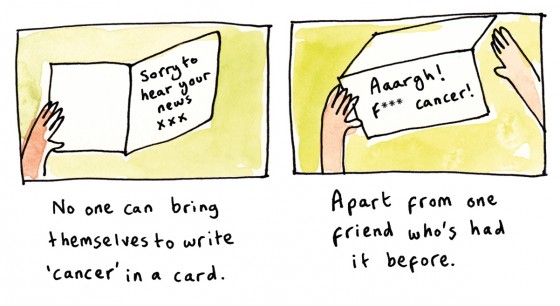
Matilda Tristram sent me her book, Probably Nothing: A Diary of not-your-average Nine Months, and it’s one of those books that begs to be finished in one sitting (I did it in two, but only because I had to tear myself away for something urgent – otherwise I could have chugged along without caring about the time!) It’s a graphic memoir that recounts her journey – from finding out she had cancer while she was pregnant at 17 weeks, to giving birth to James, and to the end of her chemotherapy. I loved it. It was honest, open, and incredibly real – I could imagine the things Matilda said in her head (you know, the things you wouldn’t say out loud!) I appreciated her humour and openess in expressing her thoughts, especially when she recounts her experience with people who mean well but could do better.

I had a chance to email her about the book, and I hope you enjoy reading the interview below!

Her book Probably Nothing is available on Amazon, and you can see the rest of her work on her website.

I love your book – your frankness and matter-of-factness of dealing with cancer AND being pregnant for the first time is just wow. Can you tell us why you decided to pen all your experience down, and how did it all begin?

Hello and thanks! I’m glad you liked it. There were several reasons; I’ve been writing stories and comics for years, for my job as a children’s author and for fun, writing about life is what I do and love.

I’d never made a diary comic because my day-to-day existence didn’t seem interesting enough, but suddenly it was. It was peculiar and morbidly fascinating (what my body was doing / the procedures I had to undergo), hilarious (how people reacted to my illness) and terrifying (the possibility that my son and I might not survive). That type of fear made ordinary things seem worth writing about. I wanted to record as much as possible in case I died and had to stop experiencing anything. My memories from the time are very clear, I can ‘see’ the wards and consulting rooms in perfect detail and remember exactly how people spoke and what they said. Scenes play over and over in my mind like frames from a storyboard so it was easy to draw.

1 month oldIt was also good to have something to do to at hospital, I was there three days a week for most of my treatment, which lasted for six months. It took my mind off the situation, while I was thinking about how to draw or word something I wasn’t thinking about how scared I was.
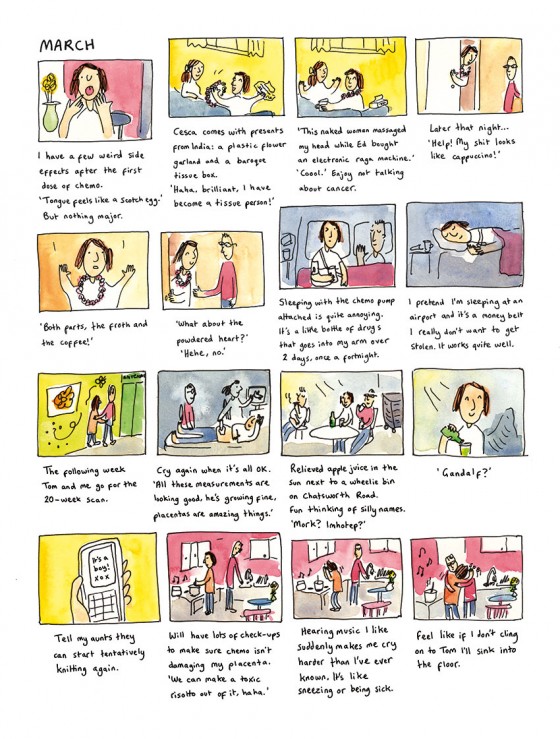
Penguin offered to publish the comic when I was about six months pregnant, almost halfway through the book. Until then I’d been putting it all online as I wrote it, to let friends and family know how we were doing without my having to have the same upsetting conversations again and again. Talking about it was difficult, but writing and drawing wasn’t at all.

Writing also meant I could gently criticise the way people talk about to ill people without having to confront anyone directly. I know people’s intentions are good, no one wants to do or say the wrong thing, but until you’ve had cancer or know someone who has, you might not realise that, for instance, talking about someone else you know who’s had cancer isn’t very helpful.

I found all the language of cancer, the ‘fighting talk’, hard to deal with too, and used the comic to question that. For example, people want to hear that you’re “thinking positive” when really you’re terrified. A popular belief is that if you think positive, you’re more likely to recover, which is complete nonsense and makes cancer patients feel guilty for worrying.

My diagnosis came quite late; the tumour was large and had started to spread. It was very difficult to get any doctors to take my symptoms seriously and my son and I very nearly died as a result. I wanted the comic to raise awareness so that the same mistakes could be avoided with other patients.

79-copy

Did you approach a publisher for the book, or did they come to you after you put your webcomics online?

After I put the comic online and then the Guardian newspaper approached me and asked to feature some pages in their magazine. I got a great response from that so approached a few publishers.

How has the response to your book been? Was it what you had expected it to be?

The response has been wonderful. The online comics and cancer communities were so encouraging while I was writing and having treatment, it was great to already have their support when the book came out.

When I read it now, I can’t believe how open I was about some things. I think at the time I felt like if everyone knew about what we were going through I wouldn’t feel so isolated in the experience. I always get emotional when people tell me that reading those really raw bits helped them through treatment or with caring for someone else.

Another response has been relief on finding that there are funny bits in the book. I suppose devastating things can also be very funny. The book is also about the rest of life as well as cancer; friendship, love, family and living in London so it’s not all heavy stuff.

20-copy

Now that your book is out and people have identified you as the lady who survived cancer while being pregnant – has this affected you in any way? Do you feel as though you’d like to move on, or are you keen to explore the topic of cancer further in your work?

I’m glad to be back at my old job teaching new students who don’t know anything about it, and working on new things that aren’t related to cancer at all.

Although I’m not making more work about cancer, I am enjoying going to conferences and visiting medical schools, to see how comics could be used to improve diagnostic techniques and communication with patients.

What have you learned from this whole experience? Of having cancer, to beating it, to having James, and then this book?

I should have some righteous platitudes ready for this bit, but I can’t think of any! I loved life before I got ill and didn’t need to get cancer to ‘appreciate the small things’ etc… I’ve had a crash course in oncology and been amazed by what my body has endured, how it has healed, and by it’s ability to produce a healthy and happy son on top of everything else. Bodies are amazing.

19-copy


Can you give us a bit of advice on what’s the best thing we can do (or say) to people who have cancer, or are undergoing treatments for it? What’s the best thing someone has said to you or has done for you?

What I loved was when people did things without asking ‘is there anything I can do?’, like bringing dinner, tidying the flat, or dropping off something nice (and non-cancer-related). All the flowers got a bit overwhelming but one friend gave me a rubber peanut and a pencil case with my favourite type of pen in, which was lovely.

Probably Nothing

You’re a teacher, animator, and writer – what advice do you have for artists who are trying to make their mark on the world?

Put it all online!

=========

Thanks so much Matilda!

Probably Nothing is available on Amazon, and I highly recommend getting a copy for yourself and/or loved ones who are going through health issues (minor or major) – it’s funny, touching, real (yes, I mentioned this several times already, I know) and best of all, uplifting.

Artist Interview: Sarah Beetson

Sarah Beetson

Sarah Beetson


I’m heading up to Australia next week for Supergraph 2015, and one of the artists who will be heading up a masterclass over there is Sarah Beetson, of whom I had the pleasure of interviewing! Read on about what makes her tick and how she ended up working with the fun people of Supergraph!

Name: Sarah Beetson
Website |  BlogShop 
Location:
Wongawallan, SE Queensland, Australia (I spend 3-6 months per year in the UK / USA)

Illustration media:
An inexhaustive list of materials which I am constantly adding to, but often includes paper, wood, photographic prints or fabric, spray paint, tissue paper and collage, Pilot G Tec C pens, acryl-gouache, markers, gel pens, crayon, stickers, vintage magazine clippings, beads, sequins, letraset…. and more.

Tell us a little more about yourself!

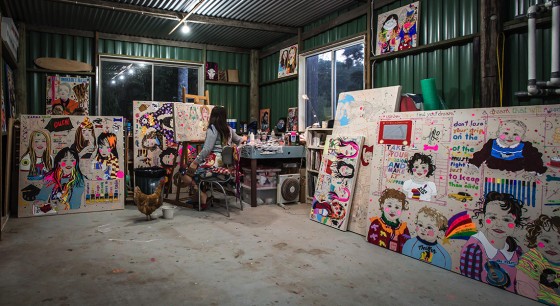
I was born in Manchester, UK and grew up in Cheshire, Cornwall, and London before moving to Melbourne, Australia in 2006, then to my boyfriends’ family farm in 2009, where I live in a converted dairy and have a giant art studio next door. As a child, my ambition was to be a childrens illustrator like Quentin Blake, and I would make my own illustrated, hand written stories a little along the lines of The Munch Bunch and The Garden Gang, both of which were illustrated by young girls. My grandmother ran a pub, so my brother and I spent our weekends there occupied with colouring in books and sketch pads. I studied Illustration at Falmouth in Cornwall, where I developed my signature style, before moving to London and interning in the fashion industry, eventually securing 2 agents and moving on to freelance illustration.

Are you a full-time artist?

Yes and no! I earn 100% of my living from illustration, working part-time as a talent scout for my agent, Illustration Ltd, and the rest of my time is spent freelancing as an illustrator and creating art for exhibitions.


Sarah Beetson


Where do you live? What stands out about living where you are, and what is your daily schedule like?

I live on a farm, which means I get to eat homegrown organic fruit and veg like avocados, macadamias, mangos, sweet potato, rocket and watermelon (and so much more!) on a daily basis! I have pet chickens who free range and will often spend the day hanging out with me in the studio (sometimes they even lay eggs in there, it’s a very creative place!) There’s also Mr Hoppity the wallaby who drops by daily, and a whole host of other wild animals like kookaburras, laurekeets, bandicoots and even the occaisional koala (on the downside, we also get snakes and spiders!) The climate is sub-tropical so we get sunshine most days, we are surrounded by rainforest and palm tress and the beach is a 25 minute drive. We are also really close to both Brisbane and The Gold Coast, so I have the best of both worlds in terms of city inspiration and uninterrupted peaceful working envoironment. My living costs here are low, which allows me to travel for 3-6 months of the year, usually to the UK but I also spend a bit of time in the US and Europe. My daily schedule begins with a yoga class, then I tend to work on my agency scouting job in the mornings, going into the studio in the afternoon to work on commissions and art projects.

Could you tell us more about your thought process when you start on a piece or a project?

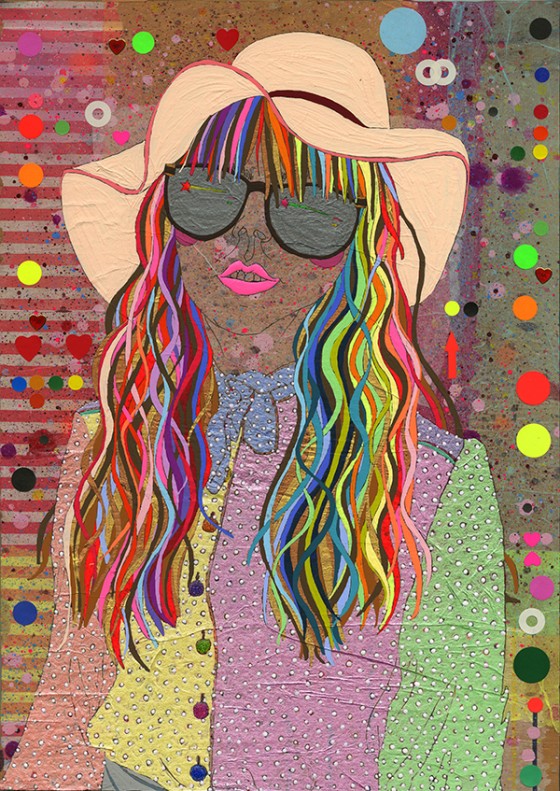
I begin by brainstorming ideas and researching the subject in question. If possible, I will then do a photoshoot to get reference material to work with, or I will source images from my catalogue of photos, books etc or the internet. I always work from photographic reference – never straight from my head – I like to give myself all of the available information before beginning a piece. I will then create sketches, if for a client, once approved I will then beginthe final art by creating a background, working on paper, wood, photographic prints or fabric, often using spray paint, tissue paper and collage to form a background. I will then create the line work using Pilot G Tec C pens. The rest is a combination of an inexhaustive list of materials which I am constantly adding to, but often includes acryl-gouache, markers, gel pens, crayon, stickers, vintage magazine clippings, beads, sequins, letraset…. and more.

Sarah Beetson


What’s your favorite project so far?

Among these have been working with Stella McCartney in the early days of her label, working with Mary Portas at Yellowdoor, illustrating for major newspapers including The Globe and Mail (Toronto), The Times and The Telegraph (UK) and The Miami Herald, winning the Creative Review (UK) Best in Book prize for illustration in 2011, being shortlisted for the 2012 Metro Award (a $50,000 Australian Art Gallery Prize), exhibiting at Somerset House, London, as part of Pick Me Up 2012, and being invited to exhibit “Rainbowspective” in Paris in 2012, showing the best of the previous 5 years of my work. Recently I illustrated Wonder Woman for Smithsonian Magazine which was a great honour, and completed a 3 month artist residency in Coney Island, New York. I am creating an ongoing body of work around Coney, my favourite place of inspiration, and I’ll be returning again briefly in summer 2015. I just finished a fantastic campaign for a very big client which I can’t disclose until July 2015 – but that one was also very exciting!

Do you keep a journal/sketchbook, and would you mind if we had a sneak peek?

Sarah Beetson

I don’t usually have a sketchbook as such, I’m not quite that organised – things tend to end up all over the studio in parts. I did however keep one during my Coney Island residency, and some of the pages from it have been turned into a colouring boom which I’m launching at Supergraph in February (image above!)

Would you care to share your studio space as well?

Sarah Beetson


What or who inspires you?

I would say film is the greatest continual influence on my work. Particularly the films of John Waters have had a profound affect on my aesthetic, in that they have really encouraged me to find my own artistic voice and not be constrained or afraid to censor myself in any way. The 1993 classic True Romance has been very influential on me — I even named my Camden Market clothing label ‘Clarence & Alabama’ after the lead characters, back in 2003. It is the candy colored, sun-drenched, palm trees and cheap motels combined with Elvis, rockabilly and ‘white trash’ culture that has saturated my work the most. I try to take in two movies a day, and can often spend a day in the city cinema hopping and taking in five or six films.
Growing up in the 80s and early 90s definitely influenced my colour palette, saturated with rainbow, pastel and neon tones. I’m sure that the colourful cartoons and TV of the 1980s, like The Care Bears, Wuzzles, Popples, The Racoons, Teddy Ruxpin, Punky Brewster, Jem and The Holograms and The Garbage Pail Kids were a big influence on my later colour palette.
In terms of other artists, over the years I have enjoyed the work of Antoni Gaudi, Gustav Klimt, Egon Schiele, Julie Verhoeven, David Downton, Antonio Lopez, Jamie Hewlett and many, many more.


Sarah Beetson

Could you share with us your progression as an artist — compared to when you first started out, how has your style changed since then?

When I first started out, my style was definately a lot more loose. I developed it by bringing together all of the different art materials I liked to work with, and combining them using the blind contour drawing technique. So early results were quite squiggly lines, and the drawing was much more rough. In the years that followed I have definately tightened up my drawing skills, and as a result, my work has a tighter finish. Here’s a then and now look at the difference:

Here’s what I did in 2001/2:

And here’s what I did in 2014:

Sarah Beetson


Sarah Beetson


What’s your favourite tool?

Hmmm, a toss up between Pilot G Tec C and Maica pens and Holbein Acryla gouache.

What message do you want to send out to people about your work?
I am happy for people to interpret it as they please, but I hope that it continues to stand out as fairly unique in an internet image led world of saturated same-same art and illustration styles.

Tell us a little bit more about your show for Supergraph 2015. What do you have planned? How did you initially get involved?

I met Mikala whose brainchild is Supergraph, a few years back through our involvement with L’Oreal Melbourne Fashion Week. We met up again whilst I was exhibiting at the similar Pick Me Up Graphic Arts Fair at Somerset House in London, and we both mused that Australia needed something similar. I exhibited last year at the Inaugural Supergraph and it was a great success, so it is something I hope to continue to do annually. Last year I gave more of an overview of my work; this year will have a focus on my Coney Island project. I’ll be exhibiting painted polaroids, as well as creating bespoke versions for visitors to order onsite. I will have a Coney Island capsule clothing collection, more original artworks, and my onsite sketchbook available as a printed colouring in book, as well as postcards, badges, print leggings, scarves, saucy playing cards, and a plethora of other goodies.

What’s next for you in the coming few years?

More travel, USA and UK this year, possibly more exhibitions with a focus on graphic arts fairs both in Australia and overseas, hopefully some delicious illustration commissions with exciting brands and publications, and developing my Coney Island body of work further.

============

Catch Sarah at Supergraph in Melbourne, Australia from 13 to 15 February 2015 at The Royal Exhibition Building in Carlton – if you’re heading there, drop me a note and let’s meet up!

1 10 11 12 13 14 74