One foot in front of the other

IMG_9838

We’ve all been there, haven’t we?

We made grand plans. Big, big plans. Ginormous plans that make us toss and turn at night, giddy with excitement. Plans that you try to hide inside you that could just burst right out of your chest in a big bloody showdown, much like in the movies. You know,  Aliens-style. But instead you grin. A secret smile that only you know why.

There’s a list. There’s even a list of lists. A list so long that you continuously add to it until it becomes this snake of a paper trail that makes you beam even more in excitement.

A dance in the dark, a skip here and there.

It’s BIG. Oh yeah.

But then.

Nothing happens. You might cross one thing, or two off that list. But then you forget.

Days pass. Weeks. Months. And then before you know it, it’s been a year. Where did the time go?!

I’ll tell you where it might have gone:

Kids. Chores. Being a household manager. Dogs. Cats. Canaries. Parents. Relatives. Simply put: we all have lives outside of our dreams.

Full-time work. Part-time work. Freelance engagements. Contract work. Shitty day at the office. Hey, all valid – we need to eat, don’t we all?

Facebook. Twitter. Pinterest. Youtube. Etsy. Ebay. No? Really?

It’s easy to let other things creep into the cracks of our already fragile plans, hopes and dreams. Nothing is holding them together quite yet.

It’s easier to see what’s right in front of us, and wanting to settle the problems that’s plaguing us before we can even try to grasp something that isn’t quite there yet. Not yet.

It’s easier to say we don’t have enough time, instead of being ruthless with how we spend it.

No time is ever perfect, no situation is ever calm enough. The baby will cry, the dog is sick (and probably vomiting all over the lawn), your house is in a mess, and you have 20 tabs open on your web browser. You’re everywhere, and yet you’re nowhere.

Breathe in. And out.

Close your eyes.

Lie down.

Face down if you feel like it. (it helps me sometimes)

Take some time to think about that BIG dream you’ve been holding on to. 5 minutes. 10.

And when you get up, instead of going straight to your kid/dog/chores/*insert whatever needs your attention*, how about you take that one small step and cross one thing off your list?

No matter how small.

One step.

And wouldn’t you know it: you’re already on your way, getting back on track.

[Illustration credit: Hilarious comics by Sarah C. Andersen]

Artist interview: Christiane Engel

Atlantis-w_700
I’m a fan of Christiane Engel’s work for quite a while through her monthly desktop calendars that she produced, until she stopped in 2012. She’s back at it again for 2015 and I couldn’t be more thrilled! Read on about how her desktop calendars helped her shape her style and what happened in between in our interview:

Hi Christiane! Tell us a bit about yourself and what you do.

I’m an illustrator based in South East England by the sea and I mainly work for the kids’ publishing market. Recently I’ve done quite a few map illustrations for a variety of clients, which I enjoy a lot.
I also love creating hand lettering and patterns.

How would you describe your style and strengths? 

I like to stay flexible in the tools and techniques that I use so there are some variations to my style. Also, quite often I find that a certain look suits one book or project better and the next one might be needing less texture or more lines, for example. However I think all of my work has a childlike spirit to it.
My main style is a collagey cut out style that uses hand painted textures, but I also use linear ink drawings and colour these digitally.

Sept ChEngelxs_1

Oct ChEngel P

You’ve been creating these desktop wallpapers since way back! I’m a big fan of them, and was thrilled when you recently relaunched it again. Could you tell me a little bit more about them – what’s your process when you design them, what has made them popular, and why do you create them?

I’m happy you like them!
There’s something I really love about calendars, moving through the months and seasons. And I thought it would be a great way of sharing my art with people on a regular basis. Over time, a style that’s less crowded and more evocative than my usual picture book art has developed and I was looking forward to creating something seasonal each month.

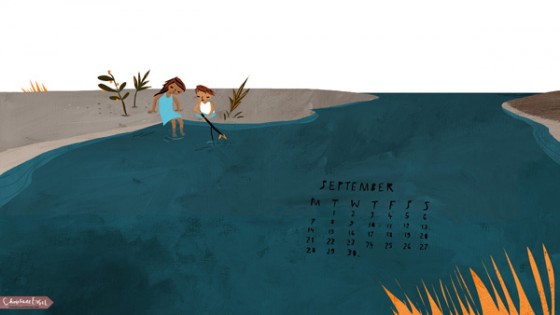
The process is almost always like this: towards the end of a month, I think of an outdoor scene and setting that I would love to be in for the coming month. In most cases I even have a clear idea of the geographical location for this. (September 2015 is by the Mississippi Delta) I sketch it out on the back of an envelope or supermarket coupon and then create the final art on my computer, using Photoshop.

Some of my calendars were kindly featured on beautiful Poppytalk a few times and were therefore getting more popular. I was really thrilled about the fact that people around the globe were using my art on their desktops as well.

However all that came to a sudden halt in March 2012 when my first baby, Maya, was stillborn. The windy coastal road which was the March image stayed on my desktop for over a year I think. This was such a life changing event that time, days, seasons and calendars did not have any relevance to me… I delved into clients work and didn’t have much space for personal projects.

But of course life moves on fast and now I’m happy that I can squeeze in the calendars again. This time around they’re inspired by my nature loving toddler 🙂 and feature scenes of an outdoorsy kind of childhood. I’m bringing together my two different directions now I guess.

You’ve been in the illustration world for quite some time now – what are your thoughts about the industry in general? Is there a big difference in the way things are done now, compared to before?

I think illustration has become a more recognized artform again and is used more widely across many areas plus amazing things can be done now with a computer.

Also it’s become easier to connect with people these days through linked in, twitter and so on. These things didn’t even exist when I was first starting out as an illustrator, even something as unspectacular as sending attachments and uploading final art digitally was still seen as something pretty amazing.

But now that I think of it, sending samples and book dummies in the post also had a straightforwardness and simplicity about it although it may seem too time consuming nowadays. The speed of things has definitely increased, and there are pros and cons to that.

colouring page1s_1

What was something you wish you’d known when you first started out? (aka what words of advice would you give to up and coming artists and illustrators?)

Never stop sketching and exploring different angles. When you’re stuck, think of something that’s part of you and your world as this will make you passionate and enthusiastic about your own work.
Thanks so much Christiane!
========

You can download October’s desktop wallpaper from Christiane’s website right here!

How to Be More Creative in the Age of Over-Inspiration

Ah, the internet. What would I do without it? It’s a portal that bounces me from one wonderment to the next – an inspiring road trip filled with jaw-dropping illustrations and illuminating interviews, with sideshow attractions of fun video tutorials to community hangouts for every niche under the sun. The internet is the gateway to inspiration on demand, and it seems like the more sidetracked I get, the hungrier I get for more.

When you have a source that beckons with creativity and inspiration 7 days a week and 24 hours a day, it’s easy to be sucked into a loop. There’s always something interesting a mere click away. I know for a fact that I’m not alone in my predicament. In the age of Pinterest, Facebook, Twitter and the many infinite scrolling art & design websites (I liken it to a bottomless well of beautiful things just waiting to be discovered) – what does this mean for artists?

The National Centre for Biotechnology Information’s research in April 2015 has surveyed that the average attention span of people in 2015 is now 8.25 seconds, compared to 12 seconds in the year 2000. That means our capacity for holding attention is 30% less compared to 15 years ago – and it’s not surprising, given how our brains are hard-wired to crave new information; according to Bruce Morton, a researcher with the University of Western Ontario’s Brain and Mind Institute.

With each click leading to the next and the more information we devour, the novelty wears off quickly, and off we go in search of better, more beautiful, more interesting things. It’s nasty cycle that perpetuates itself; leading to a host of other problems like a lack of productivity (hey, where did the time go?), procrastination (just one more website!) and for some, the inability (or reluctance) to dive deeper; to analyse and synthesise the information they’ve already visually absorbed.

I’ve talked to college students who were confused by it all – there was no lack of inspiration, and yet they weren’t inspired. They grew up with the internet being a very big part of their lives, and yet they seem to be suffering from inspiration fatigue, and couldn’t understand why. One theory that I brought up was that perhaps they’ve been looking at what was already completed and done by other artists, therefore subconsciously they didn’t need to figure out the process for themselves (hey, since it’s already been done!) Replicating something visually without finding out the underlying thought process behind it all is just like skimming the water without knowing its depths. It’s also a little like eating junk food all the time, which tastes great but isn’t very good for you.

I recommended my students to try and be more conscientious of the information they took in. Instead of merely looking at the aesthetics of the many works of art in front of their screen before jumping to the next, how about they pause for a moment and focus on finding out more details about it instead? Dig through archives of the artist’s work, and perhaps catch a glimpse of their process. Maybe it works and maybe it doesn’t (the ails of over-inspiration runs far deeper), but the reminder to dig vertically instead of mindlessly pacing horizontally might just be a good start. I needed the nudge too as I’m sometimes guilty of the same.

It’s times like these that it’s useful to remember Charles Eames’ quote:

Art resides in the quality of doing, process is not magic.

Maybe we don’t really need more inspiration. We need more doing instead.


[This is an article I originally wrote for Illustration Friday]

[Illustration: Neil J. Rook]
1 4 5 6 7 8 42