Katy Horan is a painter, drawer, crafter, and maker-of-things. She loves all things folky, spooky and crafty. Originally from Texas, she now lives in Austin.
Some of Katy’s work features in The Dazzle, a group show at Narwhal Art Projects in Toronto, Canada, which opens Sept 9th and runs until Oct 17, 2010.
{Interviewed by Melanie Maddison}
Website: www.katyart.com/
Blog: katyhoran.tumblr.com/
Etsy: etsy.com/shop/Katyart
Hi Katy, how are you? What are you working on at the moment?
I am great, thanks! I’m experimenting quite a bit these days. I am trying to balance the tiny details with more texture and looseness. I am hoping to make some large scale figures that incorporate ghost and widow imagery…should be pretty spooky.
How would you describe your art?
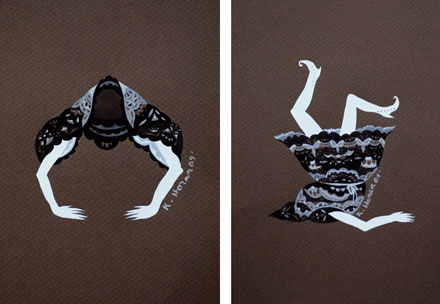
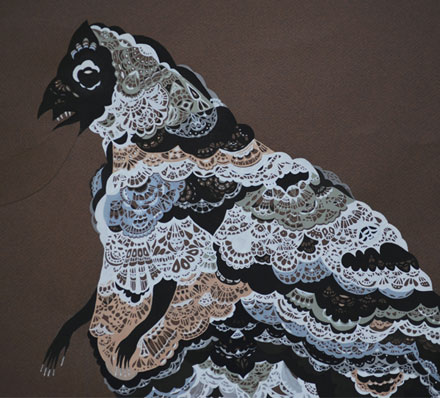
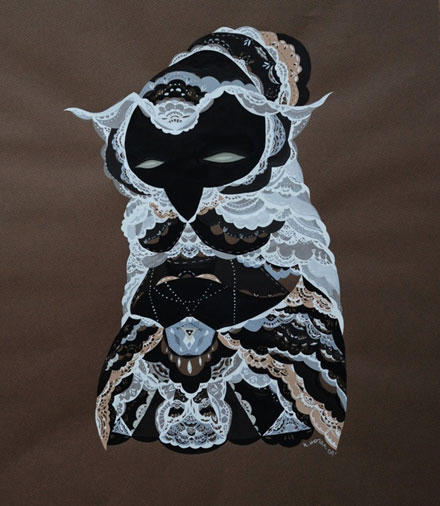
I would say I make bizarro lady monsters out of tiny lace patterns that make my hands hurt. That’s the casual version.
Here’s the formal version: I intuitively combine fragmented visual references with imagery from my own memory to create something that is both ambiguous and familiar. I do this to filter images from my own subconscious while raising questions of what we visually identify as feminine.
What are your daily inspirations?
I get a lot of inspiration from things I read, listen to and watch. I like to use my work as a filter for all the tiny pieces of inspiration I absorb in my everyday life and that remain from my childhood. Folk and ghost stories are a source that I return to regularly.
I am also really into history, so I like to incorporate visual details from the eras that interest me. Right now, I am really into Victorian mourning customs, so there is a lot of widow imagery floating around my head and studio.
How did you first get started in art, is it something that you’ve always been interested in and excelled at?
How long have you been creating art, embracing your creativity, and working towards developing your current style and output?
I always drew. As a kid, I did all kinds of other activities….dance, theater, piano….but art was the only thing that I never got bored with. It always felt more natural to me than anything else.
I always wanted to do something visual. I went to college initially to study costume design, but became more interested in children’s books than theater. I then transferred to RISD to study Illustration. After I graduated, my work gradually began shifting towards fine arts, so when galleries began showing interest and publishers weren’t, I decided to pursue a more fine art sort of path. Since then (around 2006) I have been pushing my work and process, trying to find deeper concepts and create more dynamic imagery.

How did you personally learn to access your creative and artistic talents, and gain the confidence to make art and creative expression your career?
My work is at it’s best when I work completely intuitively. I have always sought that place where the conscious mind shuts up and the work becomes meditative. I listen to audio books to distract the nagging, judgmental part of my brain, so that I can work without thought. It’s been a lot of trial and error to find the best way to get around my neurosis and ADD, so that I can just work and not worry about it!
As far as confidence goes…I am not sure how I kept that up. I am just so self conscious about everything else that it was a natural choice to pursue the art instead of another career.
And, what daily things give you the incentive/confidence/push to continue?
My work suffers when I remain attached to preconceived notions of what each piece should be. It is scary, but when I allow an image to go into unfamiliar territory, exciting and surprising things happen and I feel good about what I have made.
My studio is the safest place for me and I feel the most peaceful when I am engaged in the work. It’s my need for that peace that keeps me going. That said, it really is a hard road and many of us as artists seek some form of success or validation. I have been blessed with some great opportunities, but there have also been a lot of rejections. To keep myself grounded and my work honest, I try to keep everything in perspective, and focus on the enjoyment I get from making the work as opposed to any idea of artistic glory that I may have.

I have read of your work that you really value the connection between people and nature – hence why your art shows characters often performing ‘traditional’ tasks within their everyday environments.
How important to you is referencing ‘the everyday’ and ‘the personal’ – those simple everyday nuances of life that perhaps connect us all?
That was a central theme in my older work. I was living in New York City at the time and I think I was reacting to my extreme urban environment by creating extremely natural worlds for my characters.
My current work focus much more on singular characters. I went through a big change last year and decided to simplify my compositions so I could develop a new method of working. These characters allow me to explore historical and mythical ideas of femininity which is something that intrigues me everyday.
You have created work in many different ways, from acrylic and gouache painting on wood, to pencil drawings and work on paper, to brown pastel paper and tiny brushes. How liberating to your work is the ability for you to work with different materials and explore many different mediums?
It’s very important. It keeps me interested. All mediums have their pros and cons, so eventually with each medium, I get tired of the limitations. It’s refreshing to find a new way to execute my imagery and let go of the hassles of other medium.
I worked for a while on stained wood with acrylic and gouache. When I started exploring a new process, I turned to paper because it is so immediate and allowed me to experiment more freely and quickly.
Magic, domesticity, and femininity are all main focuses in your art; is this a direct influence from your love for folk art, and interest in what art and history can teach us about culture and heritage, or is there a more contemporary aspect and comment being made of current society through your depictions?
Honestly, I think it is because I want to escape reality. I have always been a sucker for anything that allowed me to enter another world. I totally indulge this need with my work. I have never really been interested in cultural or social commentary. Even when I am investigating ideas of femininity, it is not overtly critical. It is in part my love of feminine beauty and decoration that my work explores these themes. I think in the end my motivations are purely personal. I just want to connect to the things I find beautiful and magical!
How important do you think it is to include and represent traditional ‘folk’ art forms in contemporary artwork like yours?
I think it is very important. All these art forms that at one point may have been considered outside or less than by the contemporary art world can make our work so much more interesting and dynamic! There has been a noticeable acceptance of (for lack of a better term) “low brow” art forms such as illustration and folk art lately, and I think it’s a very exciting development for the art world.
Speaking of the nature and culture of folk art, how important is the role of ‘story telling’ in your artwork – I ask this, as I think the centrality of ‘the everyday’ in your work adds story to your images.
Story telling was very important in my older work. That stuff was extremely narrative and literal in a way. It is still important to me, but I am trying to use it in a much more abstract way. My hope is that the viewer comes up with their own narratives when looking at my current pieces.

Your work primarily contains female subjects. What is it about femininity that draws you to capture its many guises within your work?
I grew up in Texas and although the pressure to be a feminine female is everywhere, Texas excels at it! I grew up wanting to be like the pretty women in the magazine, but I was also aware that the pressure to conform to preconceived notions of what women look like was wrong. I always felt at odds with the idea that most of the pressure on girls was related to their physical appearance. I think my current work is a direct result of this. I think am trying to reconcile my personal issues with this and my visual attraction to certain feminine aesthetics.
How much fun do you have creating and painting costumes? (I’m thinking here of my favourite work of yours, the incredibly intricate lace ladies in the ‘Lady Monsters’ series)
Um, I completely love it! I have always been drawn to costume and decoration. I actually wanted to be a costume designer for a long time. From childhood to high school, all I drew were ladies in crazy outfits.
You have said that it is comforting to you to reference ‘old fashioned’ “women’s work” (quilting/sewing/sacred ritual/gathering/domestic arts and crafts/etc) within your art. Why is this?
There’s something about the gathering of women to make something for a home that is both beautiful and comforting to me. They developed these art forms as a means to express themselves when they were expected to maintain a home. I love the intricacy and humility in all of it.
*_Your work is incredibly intricate and precise, and you are very particular about the muting of colour and the role that that plays in your images. On the flipside, I read that you are fond of experimentation and a relaxed exploration of ideas.
What role, therefore, does the notion of ‘perfection’ play in your artwork?_*
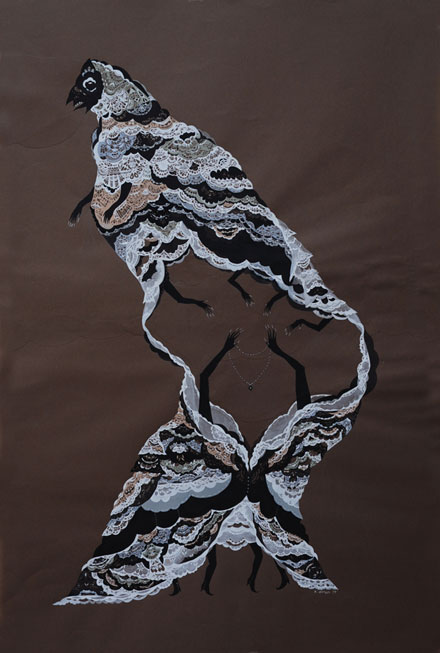
Experimentation allows me to discover new imagery. I then like to filter my discoveries through my ridiculous, perfectionist process. I like to see just how precise I can be with my line work, it’s a fun challenge and it can also be pretty meditative, which is nice.
That said, I am trying to be less of a perfectionist. I worry that the evolution of my images are limited by my need for precision. I want to see what I come up with if I experiment more with the finished pieces.
What for you are the most enjoyable or rewarding aspects of working as an artist?
Being alone with my thoughts and interests are probably the best part. In my studio, I am free to explore whatever pops into my head. If I want to learn more about the Civil War, for example, I can just research it and incorporate it into my work…Not that we need excuses to learn something new, but I love using my work as a platform to explore random interests.