Review: Lighter than my shadow

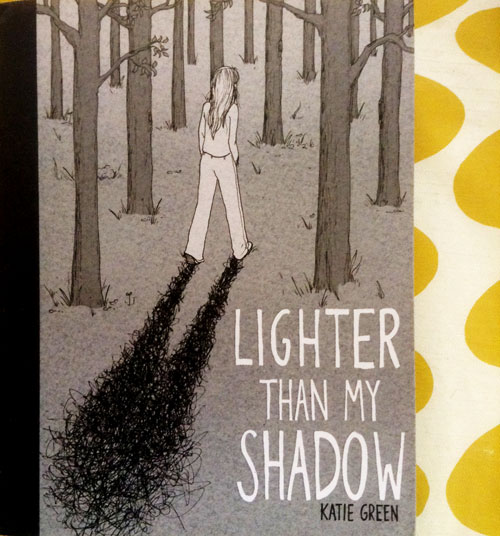
Lighter than my shadow by Katie Green

Lighter than my shadow by Katie Green

Have you ever been in a situation where you had a friend tell you a secret? A secret that they’ve been carrying all this while; one that has deeply affected them – but you had no idea before?

Lighter Than My Shadow (Amazon UK) is Katie Green’s first graphic novel – a tale of struggle and recovery; of abuse, betrayal and awakening. I’ve known Katie online for several years now and while I knew she was working on her first graphic novel about her eating disorder – I didn’t anticipate the range of emotions that bore into me as I turned each page. All 500 of it. I was curious, confused, shocked, angry – some of them all coming together in a flurry of emotions that caught me off guard as I devoured it in one sitting. It was beautiful, uplifting, and most importantly – incredibly brave of her to put her story out into the world.

I sat down with her over virtual tea for a bit of a chat about her book, and about her progress so far:

Katie Green; photograph by Chris Bertram

Image by Chris Bertram

Hello Katie! Can you tell us about the book, and why and how it came to be?

When I was first diagnosed with anorexia I went searching for a book that would tell me how to get better. I wanted all the answers and I wanted to do it right. I wanted a step-by-step guide, and I was disappointed not to find it anywhere. Every book I picked up seemed to tell me that I’d be fighting this illness at the back of my mind for the rest of my life, or that recovery was simple: all I needed to do was think positive and snap out of it. I wanted to write a book that was different. Honest about how hard it is, but still hopeful and encouraging that it can and does get better. It was always going to be a prose book until I discovered graphic novels in my early twenties – where had they been all my life?! I fell in love immediately with the language of words and pictures, and knew it was the ideal medium to express the story I wanted to tell.

What emotions did you go through as the book progressed? 

There were so many! It dragged up a lot of stuff that I thought I’d left firmly behind me in the past, so it was very emotional to be reminded of some of the most difficult times in my life. I had to really go back there, feel all those emotions again in order to tell the story well. Some days it was hard just to keep myself sitting at the desk – it was as though my brain was trying to protect me by avoiding confronting those things.

Also, interestingly, my understanding of recovery changed throughout the course of working on the book. The result was that I didn’t produce the step-by-step guide I’d always wanted. I came to understand why no such thing existed, and it drastically changed the story I was telling. It made me question everything about my recovery, my artwork, my life. It got a bit rough at times, but I think it made the book better, more honest, more real.

It was hard, but it was also immensely satisfying. Making comics is a lot about problem solving, and being something of a workaholic I kind of loved knuckling down day after day, month after month towards finishing this tome I’d been imagining for so long.

And how did you feel when you saw it on the bookshelves for the very first time?

I still don’t feel as though it’s real! It’s very strange. Even though I’ve had book launches and given talks, been on the radio and in the national newspaper, I still can’t really believe I’ve actually finished it.

How long in total did you work on the book? 

Formally, after signing the contract with Jonathan Cape a little over 3 years, but I had worked on it as a degree project before that and as a personal side project before that. From idea to publication was about 12 years, but in terms of full-time work probably about 5.

How has the response been so far?

I’m finding it all quite hard to take in actually. The reviews have been extremely complimentary, but more importantly than that I’ve been quite overwhelmed by responses from people who’ve been through similar experiences, or have friends or family who have, and have found the book insightful or encouraging, or just resonant with their own stories. To know that through sharing my story I’m reaching out to other people, well, that’s incredible.

Has the book affected your recovery in any way? While I understand that it’s an ongoing process, how are you doing these days?

I worried during the writing process that reliving the past to that extent would set me back in my recovery. My therapist has confessed she worried at one point that my unhealthy patterns around food might be returning, but thankfully they didn’t. The thoughts cropped up occasionally, but I was always able to choose not to act on them. If anything, revisiting it all in the book reminded me – or perhaps taught me – how close it all still is. While my daily life is no longer affected by my illness, and I don’t have to keep constant vigilance over my own mind, I am aware that those obsessive thought patterns are still there and always will be: they are part of who I am. Likewise though I no longer suffer so intensely with flashbacks and the after-effects of the abuse, it is still part of my story: writing it down did not make it go away.

I’m learning that when I remain aware I can direct my obsessive tendencies towards less destructive things. They can become an asset as well as a weakness. They were certainly helpful in disciplining myself to draw a 500 page book! You’re right when you say it’s an ongoing process, but it is thankfully no longer a fight, more of a curious enquiry. I’m always striving for balance, and never quite getting it right. But then seen as my struggle was a lot about striving for perfection, perhaps not getting it right is in fact as right as it gets.

What’s next for you?

Right now I’m actually enjoying a well-earned rest, although it’s been a few weeks and I can feel an itch in my drawing hand for sure. I’m looking forward to returning to my regular project, the Green Bean zine, which I’ve been self-publishing every few months for almost four years now. Aside from that, I don’t really know, but I’m quite excited to see what might evolve in the giant book-shaped space in the middle of my life.

For readers who are interested to tell their own story through a graphic novel, what advice would you give them?

Don’t wait for everything to be perfect. Don’t tell yourself “I’ll start when I’m a good enough illustrator, a good enough writer…”. Start! Make a rubbish first draft, get angry with yourself and throw it away, but learn from what you hated about it and draft again. And again. And again.

Then stop about three versions before you’re completely happy (a deadline helps with this bit).

 Thanks so much Katie!

———————–

To read more about Katie’s book and to get a 24-page preview of the book, head on to her website – http://lighterthanmyshadow.com; and if you’d like more information about Katie’s work, here’s the link to her personal website: http://www.katiegreen.co.uk/.

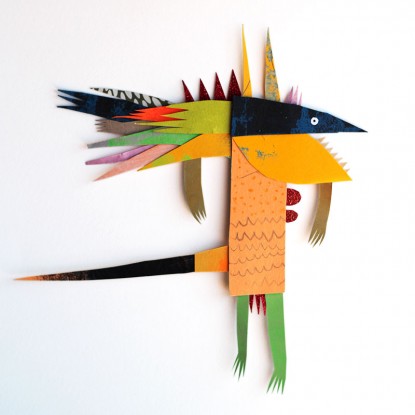
Marta Madureira

Marta Madureira

Marta Madureira

Marta Madureira

Marta Madureira

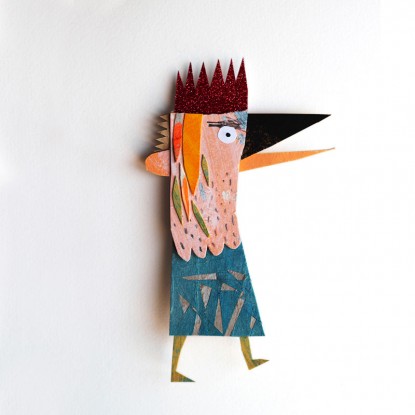
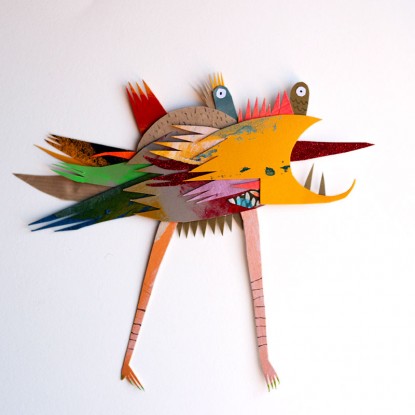
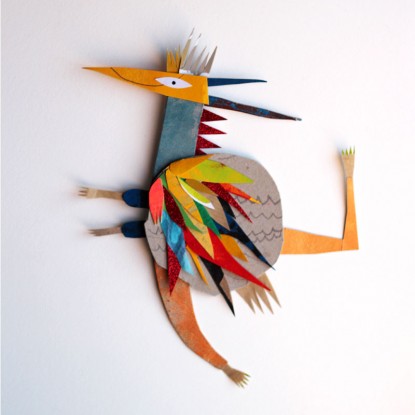
I’m inspired this week by Marta Madureira, an illustrator from Portugal. Her website only links to her email at the moment, but a quick Google Image search unearthed a lovely portfolio inspired by colors and textures. I discovered her through Pinterest and fell in love with these original works, which are up for sale at the Lusa Mater website. I think what’s so beautiful about them is how the intricacy of patterns and the bright hues of colors come together to create an explosion of unique, one-of-a-kind creatures.

Quick note: I’m going to take a break from writing for a bit and indulge in a spot of visual regurgitating until January 2014! But there’s going to be fun projects in store next year and if you’d like to keep up with me, you can always sign up for the weekly newsletter here!

[Via Telma’s Pinterest account]

Creative exercise: Close your eyes to draw better

I did an assignment with my class the other day. I asked each of them to go and wash their hands because – get this – they’re going to be feeling their partners up. Without wanting a law suit on my hands (not a sexual harassment suit either) it was to be limited to faces, and whatever body parts that stood out (pardon the pun!) in their personality. So anything goes really – as long as things stayed decent. We were going to do a variation on blind contour drawings.

From Drawing from the right side of the brain, Donna Flood:

Kimon Nicolaides, in his 1941 book, “The Natural Way to Draw,” shows the pure contour method to improve a student’s use of both senses, sight and touch. He asked that they imagine they were touching the form as they worked. To go a step further on the tactile thought it was my practice to take an actual object of whatever the class was drawing. Pass the object around to the students and with touching it there was a stronger communication to their brain as to its qualities whether, soft, hard, furry, bumpy, crumbly, etc. For instance, right around you, the keys on your computer are hard, so is the material on your mouse, also the desk in front of you is hard.

At first I told them that it was fine to look at what they would be sketching, while touching their partner’s face at the same time. And what came out from that was nothing special – there was no spontaneity, and instead there was a lot of “should haves”; things that looked like they were supposed to. Roars of laughter filled the classroom as they began to touch each other for the first time (I’m just guessing here!)

As they got more comfortable, I gave them another experiment – that they close their eyes as they were feeling their partner up, and not look at what they draw (as opposed to having their eyes open and looking at what they were drawing.) The results were amazing.

So much of what they were drawing before their eyes were shut were rigid, and focused on stylistic elements that the students were used to. In their minds they had an idea of what an eye looked like. An ear. A nose. Hair. And they allowed their hands to conform to this idea that was in their minds – and they were frustrated at the result.

From WetCanvas, Carol Rosinski:

If you think about what you are drawing too much, you are likely to let your logical thinking brain tell you what it thinks the subject “should” look like. This is where a good deal of bad drawing comes from. When you draw a bad representation of something, it’s because you are drawing what your logical brain “thinks” the subject looks like and not what is truly there. To draw a subject accurately, you have to draw what is really there. Blind contour drawing makes your logical brain shut up for a while. It can’t try to step in and correct what it can’t see and it can’t see what your hand is drawing. So the outcome of all this blind contour drawing will be that your hand will learn to draw what your eyes are truly seeing by feeling the lines and angles of the subject. In addition, you will be recreating what you see on a different plane than your subject is in.

Prior to the exercise, a few students told me that they couldn’t draw, and that their work isn’t great – but what I saw was different. When they did the second exercise with their eyes closed, their lines became more fluid. It was unhurried, with lots of detail, and a sensitivity that wasn’t there before. The difference between their two drawings were shocking, at least to me; and I think they were surprised that they produced lines they only thought was possible by others; not them.

Now if you think that it wasn’t such a big deal, think of it this way: all those great sketches that you see online of artists sketchbooks? How many of you have wondered why yours don’t look at all like them? I bet my classroom at that point thought the same. But what came out of the second exercise was astonishing – their sketches were relaxed and confident. All of them. Well the ones who kept their eyes tightly shut and didn’t cheat anyway!

Remember when I was musing about how drawing reminds me of swimming? I told the class this little analogy before the class and most of them scratched their heads. They couldn’t quite imagine how it felt – and I didn’t blame them! After the exercise ended though, I asked them again, and they started to understand what I meant. The weightlessness of not knowing what would happen, and how working with your hands to allow yourself room to float without a care in the world – or to put it succinctly, the art of letting go.

The trick is to master this even when your eyes are open, and that’s when you’ll find yourself akin to soaring in water.

Instructions: Drawing with/without seeing

  1. Take a piece of clean paper (I prefer a larger size so that your hands can roam around)
  2. Take an object, or if you prefer, choose a partner so that you can “draw” their face
  3. Wash your hands thoroughly (especially if you’re going to be feeling up another person’s face!)
  4. Put your hands on your object/partner
  5. See and feel your object/partner. Trace their outlines, examine their texture and also the memories it brings back
  6. At the same time, draw what you see/feel on paper. You can lift your pencil/pen off the paper if you wish, or keep it a single line – try both and see!
  7. Repeat, but this time close your eyes so that you won’t know what you’re drawing.
  8. Compare your drawings.

If you did this experiment, I’d love to hear and see your results! Post them up on Flickr/Facebook/Instagram and send me the link through the comments!

[Image above: Shaded blind contour drawing by Kyle on Deviantart]

——————————–

If you like reading this post, think of all the goodness you could miss out on, just because you’re busy! I’ll make it easy for you to keep up by sending you an email once a week when I write something new. Cool? You can sign up over here!

1 27 28 29 30 31 60