

In just a few short weeks, I’ll be heading down to Singapore again to attend the Asian Festival of Children’s Content 2014 from 30th May to 4th June. It’s a fantastic conference and workshop for writers and illustrators who are involved (or are looking to involve themselves) in creating works for the children/tweens/teen market.
As a way of showing my support to this incredibly enriching event, I’m so thrilled to introduce Javier Zabala – he’s an illustrator, author and educator based in Madrid who is quite the chameleon when it comes to his work! Javier together with Frané Lessac will be holding a masterclass at the AFCC on the topic of Finding Your Illustrator’s Voice, which I’m very much looking forward to. So without further ado, I’m so thrilled to share this interview with you – Javier speaks about how his parents sent him to a psychologist when he told them he wanted to be an artist, and shares his process whenever he works on a book.
I hope you’ll enjoy the interview!
Hi Javier! I hear that you’re based in Madrid – could you tell me what you had for breakfast, and perhaps you can share a random tidbit about yourself? 🙂
Hi Amy! I was born in León a little ancient town in Northern Spain in the middle of the Way of Saint James, but I moved to Madrid almost 30 years ago and I have lived there since then. I had to move because of my work. At that time, without Internet, an illustrator had to move to a big city to be near the publishers. I really love living in Madrid, but I love my hometown too, so I decided to have another atelier for living and working in summer in León.
About my today’s breakfast…I have to tell you that I’ve done it not so good. I had only a cup of coffee and three little biscuits, not so much. But, sometimes, I usually have some toast with extra virgin olive oil on it, something really tasty and very Spanish indeed, and also very healthy!
You studied illustration and graphic design at Oviedo School of Arts and in Madrid School of Arts– what led you to pursue it in the first place? Did you know that you’d become an illustrator since you were young?
I knew I wanted to become an illustrator since I was a kid, even though in that period the figure of an illustrator was not well-known at all in my society.
So, I wanted to study Fine Arts at University and I told my parents. They told me that this was not a serious problem and sent me to the psychologist! The result, being brief: I began Veterinary Medicine. Then, Law… before I found my place in the Oviedo School of Arts. Those times in a little town in Spain…
Now, luckily, everything has changed and illustration is a very well-known profession with a lot of good art schools everywhere.


How did you discover your personal style?
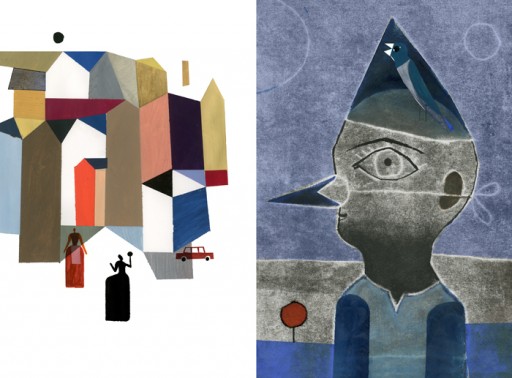
I think that a personal style, or a personal graphic voice, is a matter of time. It is ovbiously important to have it, but I think the more you look for it the less you’ll get it. It is something related to how hard and seriously you take your work and, of course, sincerity while working. It is something that happens when you’re mature enough and also has to do with all the influences you’ve received, and only if you have metabolized them properly. I think the process is more or less the same for every artist. So it was with me, I guess. It happens when you’re ready. Then, you have to develop your style, but this is another thing. I had a master from the Czec Republic, Stepan Zavrel, who used to say: “You can draw or paint whatever you want, but behind everything you do, always, your own hand has to be seen on it”.
Could you tell us a little bit more about the process of illustrating a children’s book – from start to finish?
First of all, there are no significant differences between illustrating a book for children or a book for adults, at least in how I approach the text. I absolutely need a common ground between the writer and myself for me to work comfortably. So first, I try to look for it in order to reflect a part of my personal world within the book but without betraying the text itself. Maybe, it’s an emotional place, maybe intellectual, maybe only graphic… but if after working seriously I cannot find that common ground, it’s hard for me to “get” the work.
Then, I think about the atmosphere the graphic narration should have. 80% of my time is devoted to just thinking about all these things. I think about it while walking on the street, having a shower, cooking, talking to my friends… always.
Afterwards, I make plastic and graphic proofs, tests, sketches, roughs, characters, landscapes… and at this time I try to be as free as possible and usually because of this freedom I lose my way. Then, I draw the first storyboard just to organize the narration and eveything and then, I lose myself again.
By this part of the process, I already have a general idea of what I’m looking for, but it`s only at the end when I can see how the illustrated book itself will be.
I don’t especially think about children when I create a children’s book. I’m sure they can understand all kind of graphic languages and the more you give to them the more they can understand. Then, in Europe and specially in Spain in the last 10 years, the target of picture books is often not only children but people from 1 to 99 years old, and it is very normal in our market that an adult buys this kind of books for himself. I think this is also a way of respecting children.
I usually mix several techniques and even styles in the same book and maybe because of that, I have at the end from 3 to 6 different versions of any illustration of the book and it’s only when I think all is finally done when I choose the ones that will be part of the printed edition. For me, it is important to get an appropriate graphic rhythm, but also a good narration rhythm, and finally, all the possible plastic coherence, and I choose the illustrations taking in account all these things.
Then, the book goes out of my studio and have a whole, and sometimes, very interesting life by itself.

Between illustrating and writing your own book; and illustrating for other authors, can you share with us the difference between the roles? Is one more fulfilling than the other?
I think the most important thing is to work with a good text, so if the text is not my own it is very important for me to feel comfortable with it. If it’s yours you can imagine that it fits you absolutely.
A text written by another author can make you discover new roads for working. It can be absolutely inspiring, but if the text is not good enough threre’s nothing an illustrator can do for the book, even if he makes wonderful images the final book will be handicapped.
After you discover how to sympathize with the text, the process of illustrating the book is the same as I’ve written above.
How long does it take for you to finish illustrating for a children’s book? (How long does a typical project take?)
This is a question children usually make me when I talk to them at schools! It all depends on many things. Sometimes it takes 15 days or even 4 years! I’m very quick drawing or painting because all my techniques are easy to do and quick… I’m not a very patient person! But as I had told you before, most part of the process happens in my mind, so when finally I have to face the graphic process, it can be very quick but I prefer to have a book in mind “cooking it” for months till I have clear what I want to do and tell.
What do you think of the children’s book market today? Are the themes very different from what you were working on before?
I think it has changed a lot in the last 15 years and all over the world. There are now in many countries a huge number of little and courageous publishers that are betting on new narrative and plastic proposals and this has enriched the current market a lot. I think we are absolutely free as authors to propose whatever you can think of to a publisher. Obviously, this doesn’t happen with all the publishers and not in all the markets, but you can now take your pick.
The themes however, are more or less the same. Now though, there are books about matters such as divorce, death, racism… These topics were not so frequent in the 80’s or 90’s.
What was your first big project (after you graduated), and how did it come about?
I began working before finishing my studies, but not in books.
My first book project arrived when I moved to Madrid. I was looking for work in different publishing houses and one day, in the morning, an important Spanish publisher gave me a book to illustrate, but… on that same day, in the afternoon, another important Spanish publisher gave me another project and both of them had a 25-day deadline! So, I remember that period – it was a mad crazy one in which I lost 5kg in one month! Fortunately, these two books are out-of-print!


What are some of the self promotion strategies that has worked for you when you first started out in your career?
The point is that, almost 30 years ago, when I started working, the self promotion strategies had nothing to do with today’s strategies. Back then, I walked around Madrid with my folder plenty of drawings visiting a lot of publishers in a month until I got my first commission. But now, it is much more important for a beginner to be on the Internet. Unfortunately, nowadays, at least in Europe, publishers prefer not to see people face-to-face anymore and they usually contact authors by mail and so. Maybe for this reason, the professional fairs are still important today. They are the only places where you can meet the people you work with! What a pity!
What was your most challenging project to date?
Maybe my two last projects. It can be because of the fact that they are my last projects, or maybe, as far as you grow professionaly, the commissions are more challenging… or you, yourself, are more exigent (demanding)!
In one of these two projects, “The caged bird”, the text was written by Van Gogh, the painter, (a tale he wrote on one of his letters to his brother Théo) and for me, it was difficult to get to the point.
The other one is for adults and it is a poem by Blaise Cendrars, “The Prose of the Trans-Siberian and of the Little Jeanne De France” written in 1913 and very related to the 20th century avant-garde. Technically, it was complicated as its 80 pages were bound as an accordion and all the plates had to be connected. The result was a 25 meter long illustration.
I enjoyed myself a lot with these two projects!
You also teach and lecture in universities on illustration – what’s your advice for someone who is an aspiring children’s book illustrator?
You can only illustrate like you really are. I think if you want to become an illustrator you have to fill your head of good influences. So, you should read a lot, listen to music, go to the theatre, go to the opera, cinema… and of course visit lots of art museums and exhibitions. This is for me the most important part of the learning process. As an illustrator, you’ll have to narrate, and not just draw. If you have nothing inside its impossible to give anything.
Then, obviously, you have to draw a lot, paint a lot, go to fairs, know the history of art and works made by the masters of illustration in the past and today… There are also a lot of courses and good schools of art everywhere to help you develop your skills.
And finally, if possible, become a friend of a professional illustrator. They are usually very accessible. The more talented they are, the more easily reached they will be!
Thanks so much Javier!
==============
 Check out more about Javier’s work via his website, and come on down to Singapore in from 30th May to 4th June 2014 for the AFCC to say hello! More info about the AFCC, including the whole conference schedule over at their website.


