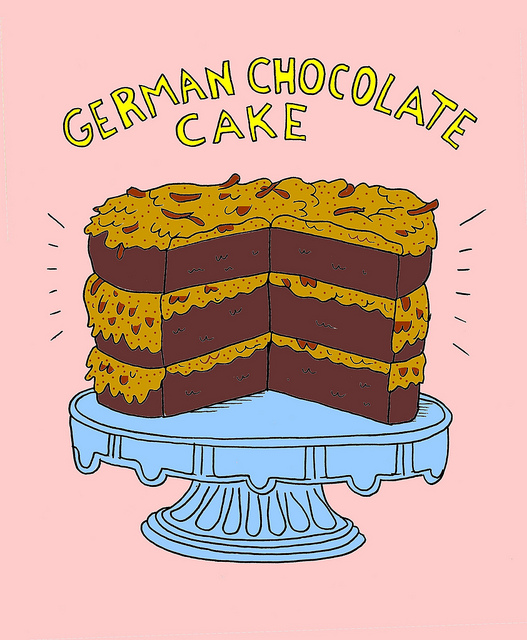
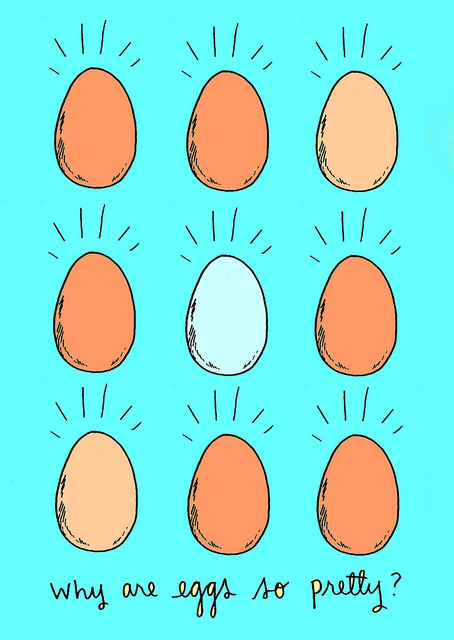
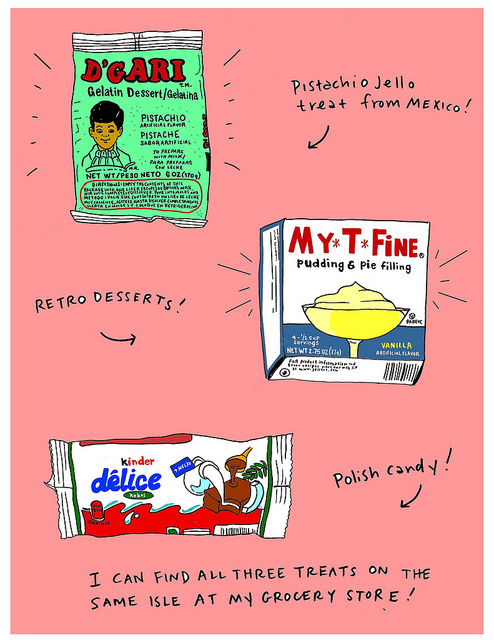
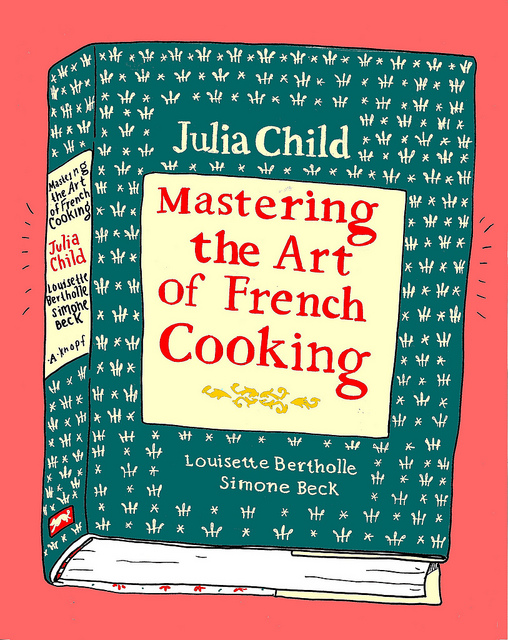
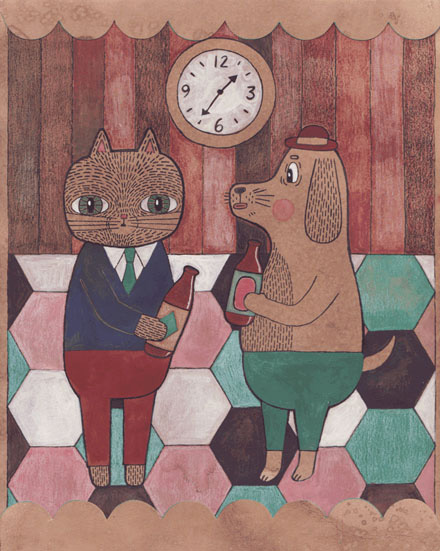
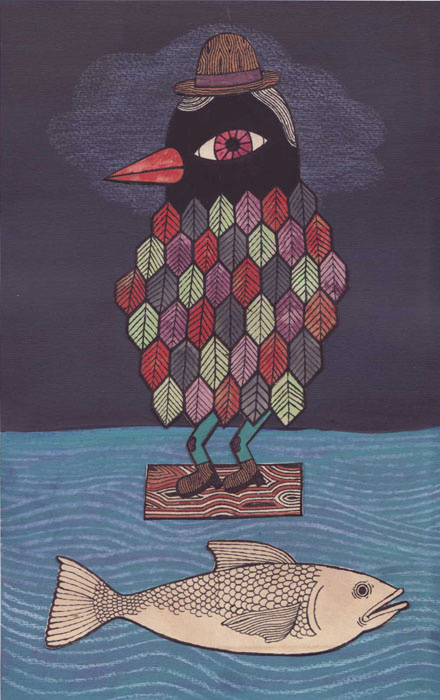
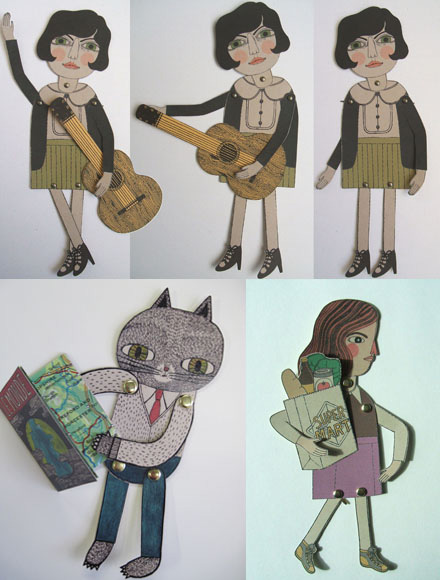
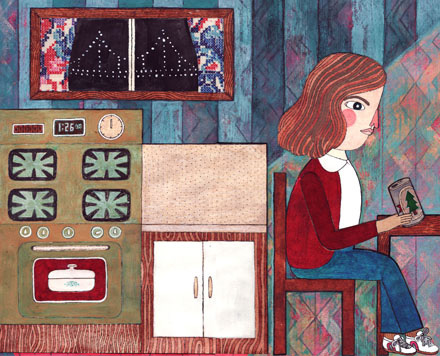
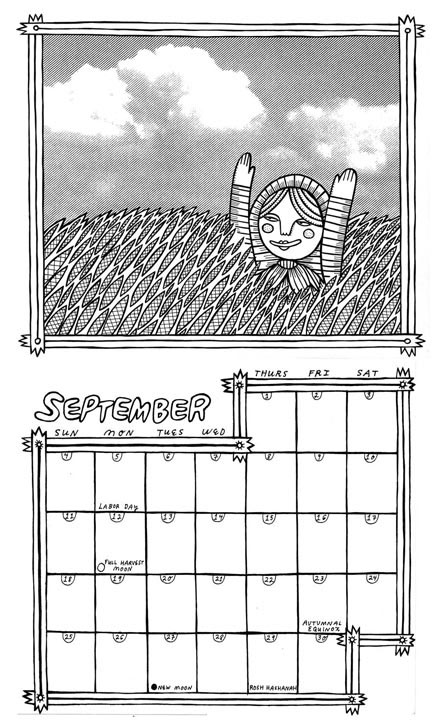
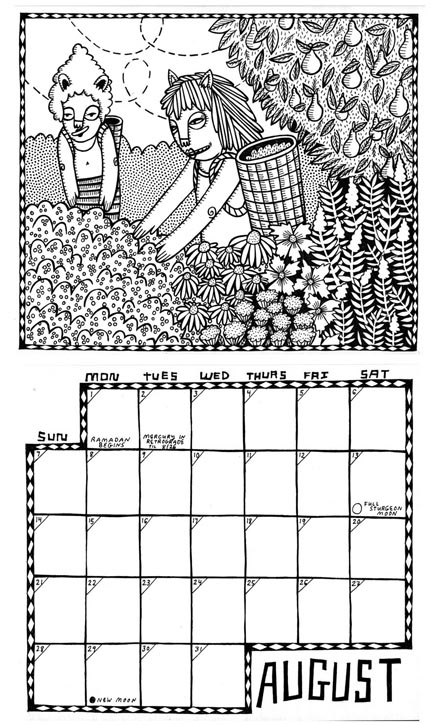
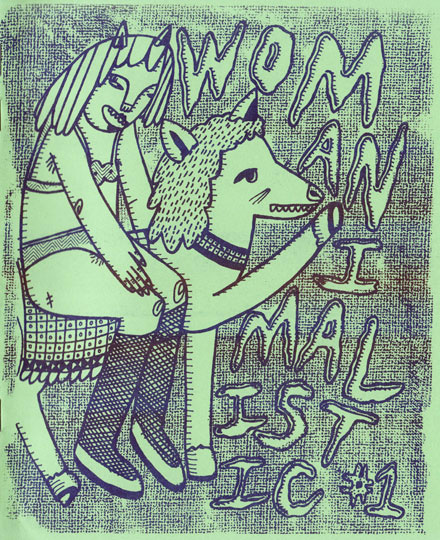
Brooklyn, New York–based artist, Caroline Paquita, is the DIY-spirited artist behind the zine, ‘Womanimalistic’ and the yearly Paquita Calendar (which Pikaland featured in our rundown of the best 2011 calendars).
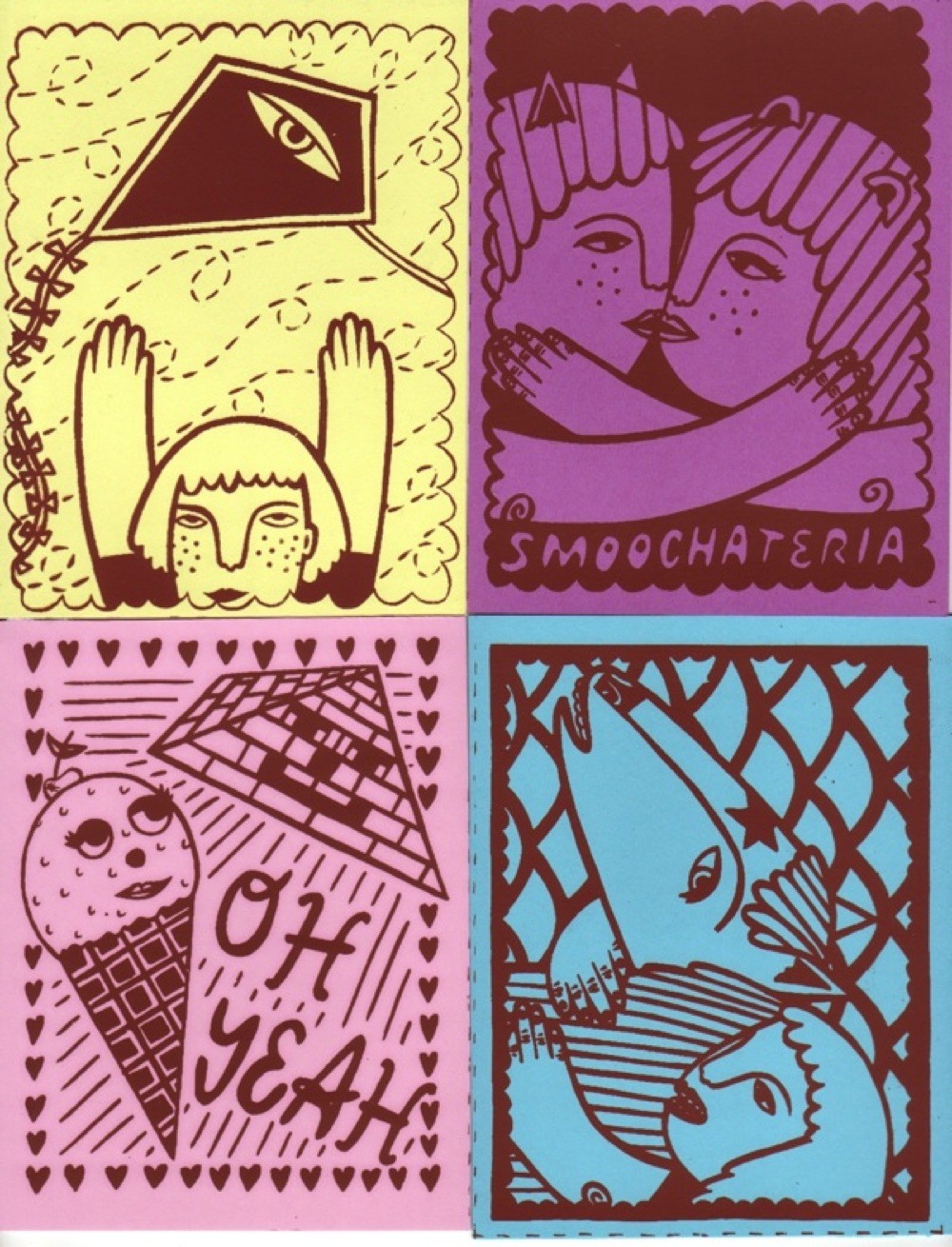
Her accessible lo-fi visual work is regularly produced with her own Risograph printer, lending it a distinctive and characteristic appearance and impression.
Caroline’s work takes much inspiration from nature and our environment, and her daily life and lifestyle feature heavily in her artistic practice. Her work helps create visual reminders for keeping motivation and everyday actions afloat. It aims to foster an environment and a positive space where the imagination and one’s intuition are actively encouraged, and where people can feel empowered via real objects, such as zines, prints and other tangible art.
Caroline is currently raising funds for her latest venture, Pegacorn Press, via an Indie GoGo funding drive. More details of this art publishing house (alongside a really great video showing Caroline’s art and printing processes [plus her chickens!]), can be found here.
Website: www.carolinepaquita.com
Blog: carolinepaquita.blogspot.com
Etsy shop | Pegacorn Press
Hi Caroline, how are you? Could you tell Pikaland readers a little bit about yourself and your art work?
Hello Melanie! Hello Pikaland! I’m doing great because I love summer a ton and this one in particular has been pretty amazing!
In regards to myself and what I do? First and foremost, I’m an interdisciplinary artist, who has dabbles in music here and there when the spirit takes me. The two meld together when I’m in bands and do artwork for fliers, records and whatnot, but predominantly, I’m more inclined to say that visual art is where my heart and soul really reside. Though I’ve done everything from drawing, painting, printmaking, photo, video and sewing- my mainstays this past year have been working on drawings for my zine, sketching up new paintings to work on this winter and learning animation.
What are you currently working on?
A couple projects that are on the table right now are: working on the yearly calendar that I have drawn and printed myself for the past two years, developing new comics and also putting together Pegacorn Press. The Press has been a project long in the making and something that I’m extremely excited about and like a mother, feel very proud of. It’s a small, queer, feminist, total-art-freaker publishing house that will specialize in small-run art books, comics and zines. The calendar, as well as a comic compilation (that will feature roughly ten different artists), is scheduled to be released this fall. All that being said, there is a ton of work to do in the meantime!
What is your artistic history, have you always drawn from a young age, did you go to art school? How did you first become interested in art, get started in making and creating art/embracing your creativity, and realise that it was something you would like to pursue?
As long as I can remember, I’ve always created objects, drawn, and been engaged in some sort of artistic practice/process. It’s something that keeps me alive and refreshed as a person. My childhood in Miami was spent in special public school programs for “artistic” children and I feel fortunate that I was encouraged to develop my skills at such an early age. My mom, grandma, and great-grandma all were/are crafters/artists to some degree and to have a lot of supplies around the house, wear clothes that someone in your family actually made, and in general, have evidence of handmade things all around our house definitely instilled the DIY attitude in me by an early age.
I have a BFA in Creative Photography, with a minor in Art History. While I was in college, besides the photography, I worked on a lot of printmaking, comics, zines and played in a band that toured here and there. I travelled around the country fairly often and began to meet more and more folks who were artists/makers. It became more obvious to me that it was okay to live a more “unconventional” lifestyle (AKA, I could live however I wanted- I could create my own destiny!) and I’ve been working on setting that up for myself ever since.
I’ve always known that I’d be an artist (in my mind, I’ve always identified as one), but it’s most definitely, a difficult thing to try to make an income from. While the money from art comes in periodically, at some point soon, I’d like to attend a graduate program so that I’m qualified to teach on a college level. I’ve had so many truly amazing teachers in my life, that I honestly grew up thinking that all artists were teachers. Obviously, that isn’t the case, but hopefully it will be for me. I thrive off working with others, creating together and love to help problem solve. Without a doubt, I’d still work on my own practice!
How did you personally learn to access your creative and artistic talents, and gain the confidence to make, sell, and exhibit your art?
I’ve always felt a certain confidence in showing/sharing my work, so that hasn’t necessarily been something that I’ve had to learn as an adult. I do believe, however, that I could still “tighten up the ship” a little bit, and still strive to learn the best, and most proper, ways to create and exhibit my work. It’s an ongoing process, you know? It would seem stagnant if I supposedly just had everything figured out, with no room for growth in any way.
In regards to selling, that’s definitely still something that I’m working on. I have an Etsy store, sell to independently owned stores around the US, and also have the necessary tax identification number to legally sell art on the street in New York. I have gone through phases of trying to street sell, but usually my stuff is so specific that most people are either shocked or weirded out, that I’ve rarely made much in these adventures. It still can be fun to head out there though and I’m working on a new set-up, complete with a new bike cart that I’m welding myself!!!
I’ve gotten a lot better with getting my zines (and yearly calendar) in stores around the US, but find it difficult (and annoying) to keep track of my accounts with them and usually end up having to seemingly beg to get paid. I wish that there was an easier way to do this (particularly one where you don’t have to compromise your work too much), but I still feel better about managing all this myself, rather than working with some of the somewhat too-dominant distros here in the States.
What prompted your move from making and working predominantly within music, to your focus on your zine, illustration, printing and design work as well?
The reverse is more true in this case, as I would say that first and foremost, I’m a visual artist and always have been. As an adult, I’ve learned to play music and it’s one of my main focuses, but visual art always ends up being the core of what I do. Playing music often requires other people and is obviously a collaborative endeavour- which is a truly an amazing and unique process. It can be very cathartic experience not easily re-created alone, but it can also be a terribly public, which at times can be unnerving and distracting for me.
For myself, making my own work is a means for me to sit alone, process my emotions, think about the state of the world, time travel and meditate! I can do it whenever I want, and am not dependent on anyone else’s schedule. Trying to juggle the two, however, is a job in itself, but there are times when I’ve found a good balance and a way to bridge the two together, in the forms of fliers, posters and album art.
I’d like to ask about the sorts of stuff you like; what images/artefacts keep you company in your studio / place(s) of work, for inspiration?
My room is full of objects and I’m continually in a state of moving things around to keep things fresh. Specifically around my desk, currently there is a framed antique embroidery, a print from my deceased Granny, another print by an old friend, photocopies of old beekeeping etchings, and a shelf full of pens, markers and other most commonly used tools. While I’m working, I keep picture files and collect books of images and patterns as reference close by. The rest of my room is full of antique bottles I continually find at this old dump from the early 1900’s, bones, herbs I’ve collected and tinctured, plants, trinkets and friend’s art.
I’m about to move my studio into my partner’s bike frame-building shop and the plan is to construct a little shack within the shop. It will be the clubhouse that I’ve always wanted! It’s exciting to think about not working in my bedroom as much and to create an environment that is all about art, where I can’t get so easily distracted.
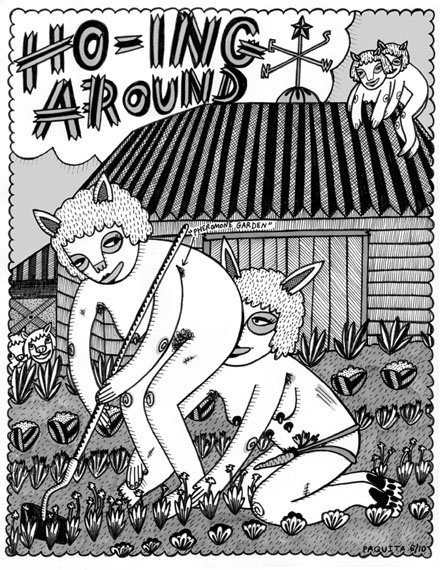
Your art has regularly featured powerful work around themes of nature, herbalism, bee keeping and DIY health care, amongst other things.
What are your thoughts on the politics of sharing such information within art?
For example, do you see your art work as an opportunity for the creation of an insightful space for dialogue and communicating ideas: promoting accessibility of ideas and participation/engagement with them; or perhaps as a way of engaging viewers with inspirational politics; or simply creating a visual reminder of the power of human energy/creativity and what we are possible of doing and responding to within our everyday lives?
In every way possible, in my daily life and in my artistic practice, I’m all about trying to create a space where all of the above is possible. How else do we learn, create/develop relationships, change our lives and environment- unless dialog and information sharing is possible? I definitely believe in visual reminders to keep the positivity afloat, the message alive- to keep the “magic” circulating.
In regards to the recurring themes of herbalism and DIY health care? They both have basically saved my life. I was ill for a long time and have fought for years to get my health back. Repeatedly, doctors told me that the repetitive stress injuries in my arms were untreatable and that reoccurring battles with MRSA staph (that would land me in the hospital on an IV for a three-day cycle of antibiotics) was just something that I just had to deal with. That there was nothing to do! I just refused to buy that idea! My health was in a terrible place and honestly, when everything else doesn’t work, that’s when folks get into herbalism. That’s exactly what happened to me and it’s not like I wasn’t living a relatively healthy lifestyle before all these complications started occurring.
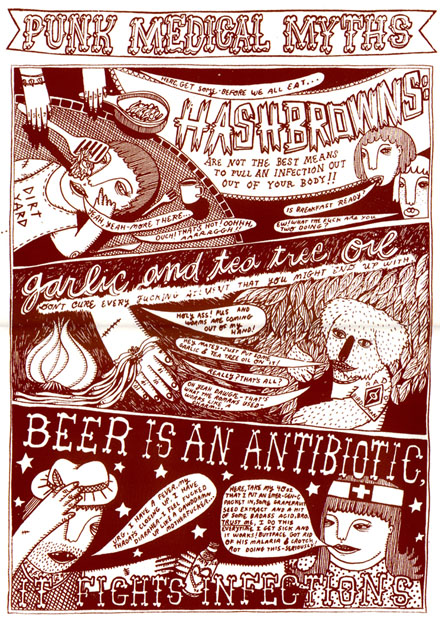
Since I don’t have health insurance (like most Americans), I’ve learned to depend more so on self-diagnosing and from self treatment for non-life threatening conditions. I’ve also heard a lot of really bad advice about self-treatment, which is what inspired the comic, “Punk Medical Myths.” Multiple people have told me that the comic helped push either themselves, or a friend to go seek professional medical health. Whew! This is where art can be helpful to the public and save lives, even in the humorous format of comics.
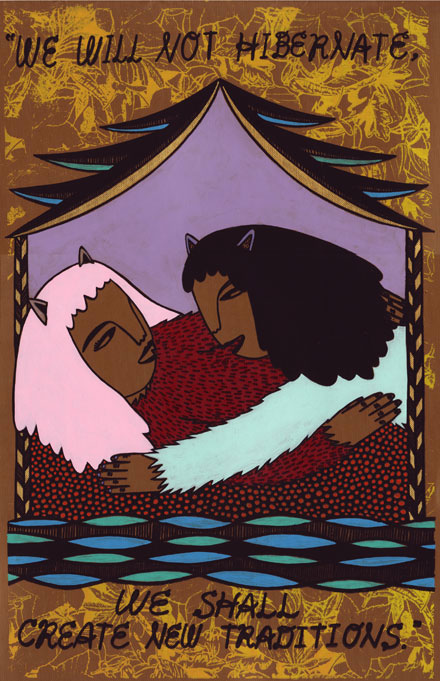
Your most recent zine, Womanimalistic is terrific. Are you planning a second issue?
What does the title ‘Womanimalistic’ mean to you?
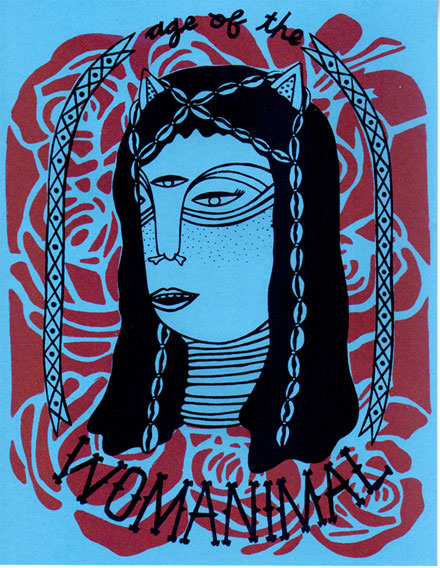
Womanimalistic #2, tenatively called The Coochie-Party Issue, is in the works already- I’m super excited to enter that creative space again. It may be easier to explain the concept of the WOMANIMAL, which is a larger body of work that I have been working on for the past four years now. The zine is an extension of this project and is an easy format for me to easily share with others.
“WOMANIMAL” is a platform for me to engage in critical thinking from a “queer, woman-centric point of view,” that investigates the current state of modern culture and that also helps foster an environment where the imagination and one’s intuition are actively encouraged. Through this process, my work seeks to inject more constructive criticism, absurdity, sassiness and fierce energy back into all things queer, feminine and deemed feral!”
I’m tired of the negativity that has surrounded my generation and the hopelessness that war, consumerism, and modern culture has helped promote. I’m not a luddite that lives in a cave (though I jokingly call myself an “urban primitivist,”), but I feel that so many people right now feel really distant from THEMSELVES. I often find myself wondering WHY? Is the cell phone, the Internet (or the combination of the two, the I-Phone) to blame? I don’t have the answers, but I do know that people are so distracted these days that it’s hard to know exactly what’s going on. Making art is one of the ways that I feel like I can contribute to creating a more positive space where people (particularly women, queers, and their allies) can feel empowered via real objects, such as zines, prints and other tangible art. This is the core of what WOMANIMALISTIC means to me!
*_
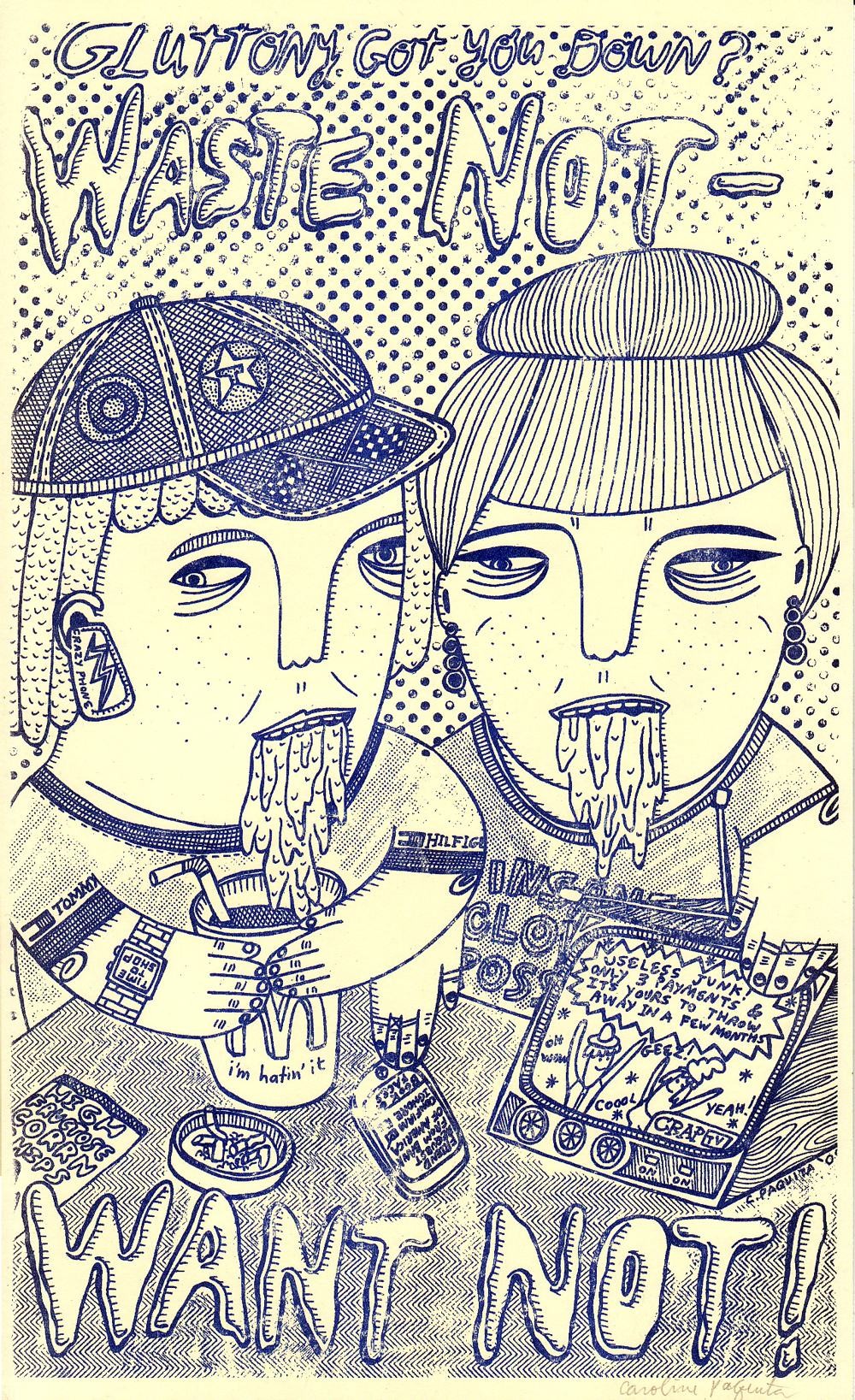
Do you think comics/zines are a good way to share art, to display art, and to reach (new?) audiences or artistic communities?_*
Zines and comics are one of many ways to reach out to a larger audience, though it seems that people mainly under forty seem to be the one’s paying close attention. I’ve noticed a renewed interest in all things printed- particularly if it borders the line with artists books- that has extended into a whole different realm of makers and other folks that have tapped into that world through sites like Etsy. I think that some of what I’ve been working on does fall into all these different audiences/communities, particularly gauging on the response that I’ve gotten since putting Womanimalistic out. So long story short, yes!
What techniques of illustration do you most prefer to use; what are your tools and materials of choice?
What stages, from start-to-finish does a typical piece of your work go through, and over what time frame?
For my illustrations/comics, I’m pretty lo-fi in many ways, though I’ve recently started incorporating the computer in the final production stages. Pencil, a couple Rapidiographs/Microns, and some Bristol board are my main stays- though I sometimes delve into brushes and quill-pens. If the work is being sent to a printer, I might use some Chartpack grayscale pens to get some gradation, otherwise half-tone pattern is something that I often use.
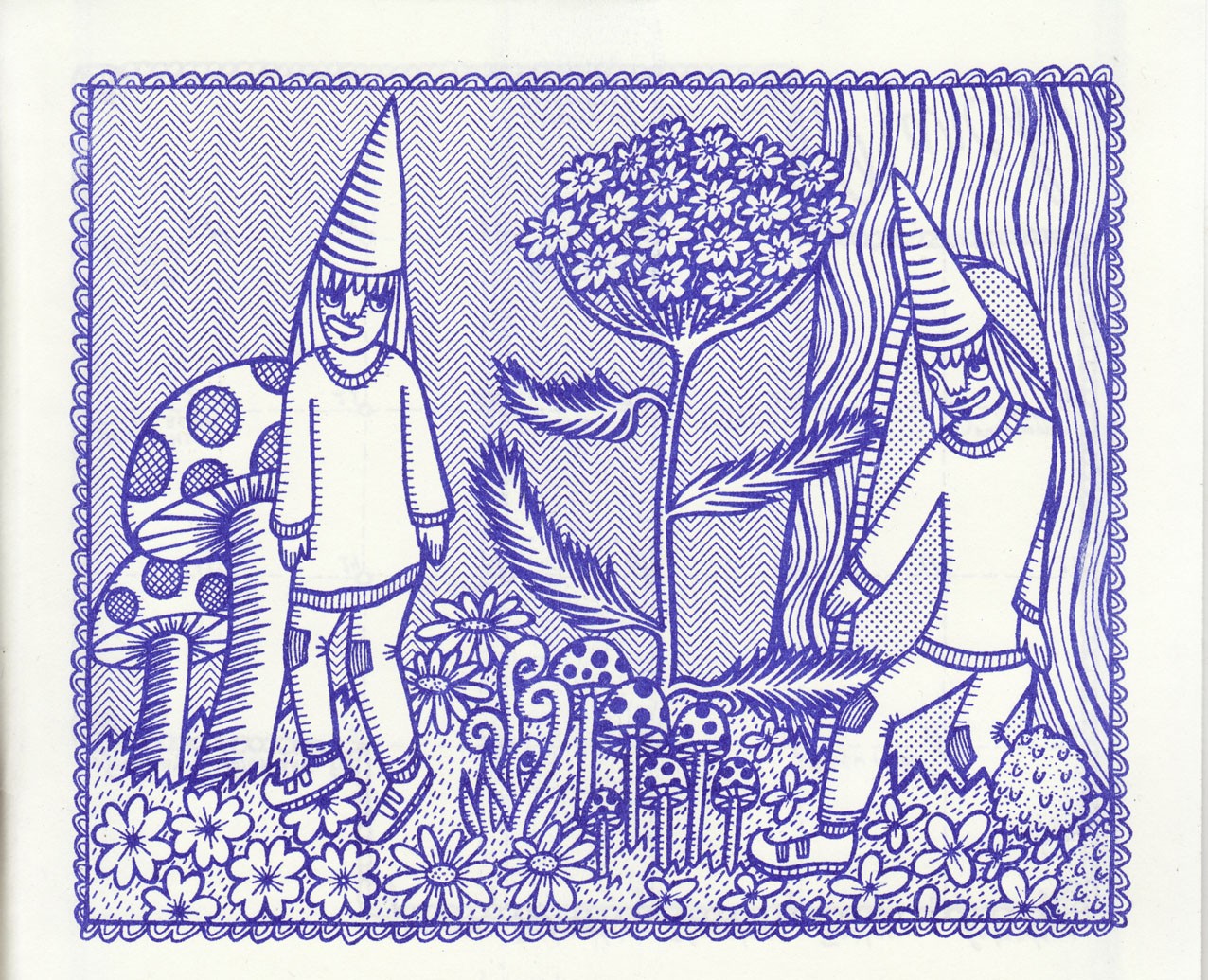
A lot of my personal work these days has been one color, mainly due to the fact that until recently, I only had one working color drum for my Risograph duplicator. Like most people, I tend to work larger than the expected dimension, scan for resizing/layout and to also possibly add patterned backgrounds/halftones. It’s a pretty straight-forward in many ways, but always seemingly time consuming!
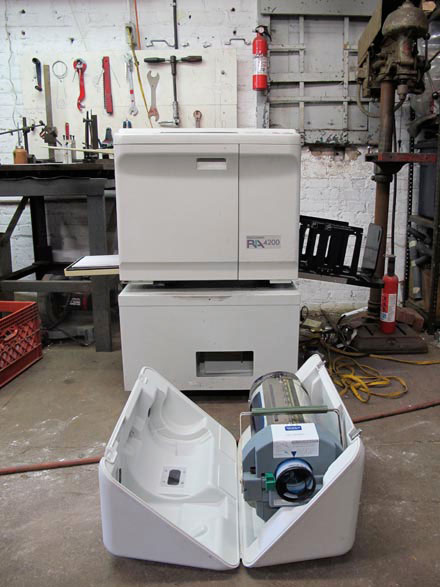
The majority of your work that I have seen has been printed/reproduced using your own Risograph duplicator. I love the printed effect that this creates. How useful is it to have your own means of printing and duplication available at your disposal? Has owning the Risograph affected your productivity and prolificacy, or perhaps affected the type of work that you now most regularly create?
Getting my own duplicator has definitely changed things: I’ve never been in a position where I could afford to send things to the printer and now I can print things in my house whenever I need it. After the initial cost of the machine, I’ve basically just had to buy the ink and paper to keep it going. My Risograph is from the 1980’s and has made over 2.5 million prints before I got it, but it’s still working- I say this with fingers crossed!
There are some definite limitations though with the quality that you can achieve, but that’s the trade-off. If I know that a piece is Riso-bound, I may simplify some of the line work in my drawings and avoid having large filled in areas, since it will eat up ink and make printing harder. That challenge has made me work differently, but I’ve appreciated the fact that it’s made me have to think a lot more about my drawings, way before I even start them.
What are your thoughts on your ability to personally turn out your own prints, zines, exhibition materials yourself by hand, and the effects this has your sense of actual human participation within, and attachment to, every aspect of your work’s creation?
My involvement with every part of the artistic creation of an object definitely makes things seem really “real” to me. For every page that I print, I’ve probably touched that single page about ten times (or more) before it’s made it’s way into someone else’s hands. I print in large stacks, use a hair drier to set the ink faster (and to prevent “ghosting” on the backsides), reload the stack to print the other side, blow-dry again, then collate and staple- all by hand.
Maybe people can feel that? I know that I can tell when I pick something up whether it’s just been pulled out of the box from the printer and sold, or made by the artist/printer itself. I know that it’s not an option for everyone (due to time, money, resources), but it’s been a conscious effort in the past couple of years to set myself up with my own printing equipment. It’s been worth every penny spent and has made it so much easier to distribute my work than ever before.
Your work has featured in independent publications such as ‘Maximum Rocknroll’. To what extent does the punk and do-it-yourself spirit drive your artistic creation, production and expression?
It’s the backbone of my work, but definitely not the whole, as my life is more varied than just being a punk who is very much DIY spirited. I’m still very much involved in that community and will do art for MRR at the drop of a hat, but as I’ve gotten older, my ideas of punk and the DIY have definitely changed and developed over time. Most of the world isn’t too fond of anything queer and/or feminist and unfortunately, the world of punk is no different in many ways. So while punk is an old-mainstay, I don’t feel limited to that identification.
These days I’m more inspired by people who are just straight-up DIY; the weirdos who just want to figure out how to make things themselves, who avidly learn how to live without all this technological nonsense. Folks who are retaining the spirit of creativity and want to dork out with other people about what they’ve learned. As a beekeeper, the doors to a netherworld have been opened to a lot of insanely great, but extremely weird folks, who also keep bees. For some reason, only true weirdos get into keeping these tiny insects and I’ve pulled a lot of inspiration from them, as well as from my other “special-interest friends,” the wild-crafters who gather herbs and wild-edibles. To eat wild rice, maple syrup, seaweed, or to drink herbs that you or your friend’s harvested, is inspiration in itself!
Community (artistic and otherwise) and support appears to be something that drives a lot of your work, its themes crop up a lot in both the subject and overall ‘feel’ of your work, as well as often in the medium of your work (fliers for local events, band art and posters, local signage)
How important to you is working within and for a community of (creative) people?
What does ‘community’ mean to you, as an artist?
On a micro level, community is all we have. I don’t want to live in this world alone: not be close to anyone, not learning, loving or sharing with others. I’m definitely not scared to spend time alone (my work does keep me locked up at times), but what I mean to say that I want to engage with others and help work to have a larger, supportive community that people can depend on. I’m into sharing my skills and art to people who want or need it. I’m a part of a larger artistic community (that spans across the whole world!) and it means a lot to me to be able to share that with not only other artists, but with everyone who appreciates art.
I’m fortunate to live in a more collective-like home, owned by two of my roommates. We do a lot of urban homesteading (keep chickens, bees, we garden), run a CSA (Community Supported Agriculture- a farmshare) out of the house and several of my roommates are in Bread and Puppet, so there’s always theatre props around the house. Someone is always making something around here and there’s usually a group of people who’ve come over to help make it happen. That’s community! That’s our “chosen family,” being supportive and enabling each other to keep making great work. So, so, very important!
What are your top tips for others who wish to be creative but feel stuck, don’t know where to start, or feel like they aren’t ‘good enough’ to do so?
*_What are your thoughts on the nature and exclusivity/inclusiveness of ‘art’ — Do you believe everyone can be creative in their own life?
I do believe that everyone has the potential to be creative- it’s just a matter of harnessing that energy and going for it. Most people are naturally curious and if you practice anything enough, you have the potential to become a master at it. I’m a true believer in this, but it’s sometimes hard to help people understand that this process can take A VERY LONG TIME. It’s often not an over night endeavour at all, unless you are naturally inclined and can just automatically pick up new talents. Most people do not fall into this category (including myself), so don’t be discouraged and just keep plugging away!
A large, and often overlooked, part of making art is learning the craft. That process can take a long time and you just need to try, and to forge ahead with an open mind. The challenge is to push yourself and your boundaries- try new things! Check out every book in the library and read everything you can about whatever it is that you want to create. Practice using the tools, ask other people about their process and put aside a regular time every day, week, whenever, that you’re going to work on it. Just like they say, “Practice makes perfect!”
I once read you claim that it is important to you to make your art financially accessible to everyone. What is your personal motivation for this?
It’s less of a claim and is an actual statement on my website: if people desire my work, but don’t have the financial means to pay for it, I’m totally open to trade/barter. My life is very much based in this world and when I’ve been super broke and needed things, I’ve often traded art/art services for everything from a computer, haircuts, medical services to help building a bike.
While it would be nice to live a life where, “I can be leisurely and just create art, la, la, la…” I’m a total realist and still work “real-life” jobs to pay the bills. I don’t want to compromise my art/vision by depending on big ticket spenders to be the only ones with the means to buy my art. I also don’t want to cater to that community. I work as an art handler and see on a daily basis how insane the “art world” is. It’s often been an alienating and disenchanting environment for me- and I’m someone who is very appreciative of other artist’s and their work. Over and over again, I’ve witnessed how an artist’s work can easily change when money becomes too entangled in their process and I can’t say that that is something that I’m necessarily attracted to. I do believe that people should be able to live off of their talent and skills, but sometimes things get a little too decadent/bourgeois for my personal tastes.
All that being said, when I’m selling in person, often my prices are sliding scale and everything is negotiable. This can be confusing for some, but it does open up a dialog and challenges why art often has quite a large price tag. Since most of my items are paper, I’ve printed them myself and I’ve often already covered my basic costs, I do have the option to be more flexible in this regard. With items where there aren’t multiples, yes, prices go up- but it’s still usually “affordable” for a one of a kind piece. I truly believe that everyone should be able to have art that they love around them, so if someone is really wanting something that I’ve made, there’s usually some way that they can have it!
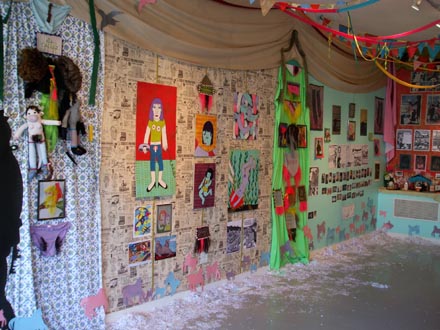
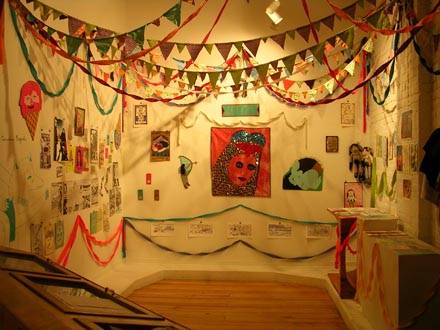
I was looking on your website at the photographs from some of your past exhibitions. They look like the most fun exhibitions I’ve ever seen; so very far removed from the idea of a ‘stuffy art gallery exhibition’ and completely up my street! Totally jam packed with colour and texture, and often over-spilling from the walls. How much fun have you had exhibiting your work, and how important to you is showing and creating work in a way that is true to you?
All the shows that I’ve done have taken a lot of energy from me, but have been totally fun to set up. It’s really important for me to be able to show the work in a less “formal” environment- meaning that the walls don’t have to be flat white, everything hung straight in a line and framed with mat board. I’m scrappy, the work can be spilling everywhere and also, it’s just not in my nature to hang only a few items. My shows often are comprised of a whole era of work and have a lot of things going on within them. They’re very much representative of my life and personally, so it’s really important for me to show in places that I care about in some way or another.
Looking back, it seems that I’ve shown more in non-profit art spaces, and very rarely in privately owned galleries. I feel like that says a lot about me, my work and the audience that I’m seeking to connect with. I’m a fairly “no-frills” kind of personality and it means more to me to show to people who really appreciate what I’m doing, rather than just to show at the best gallery to “be seen” at an opening, etc. There’s a lot of apathy that surrounds the art world and that turns many people off from wanting to learn more about art/artists. My main mission as an artist is to create environments that are inviting and that make people feel inspired, whether that be artistically, politically, etc.
How do you manage your time in order to devote as much time as you’d like to your art?
Time management had been hard for the past couple years because I was in a very time-consuming band that toured quite a bit, which made it difficult for me to do my own art as regularly as I wanted/or needed to. Since I recently quit the band, I’ve been able to immerse myself back into my personal art world and it’s a really positive and rewarding feeling. I work part-time during the week and try to come home after work and put in some hours, if I’m not too tired. Days off are usually spent drawing and flushing projects out. It kind of seems like I’m always working? It’s a form of entertainment, I guess, since I don’t watch TV, go to movies or hangout in bars that often.
What is your favourite part of artistic creativity? Why do you keep on going and doing what you do, and what gives you the incentive/confidence/push to continue making your art?
I’m a maniac, like most people who make art. You get the FEVER sometimes and just can’t stop working. You’ll stay awake for hours on end, drawing, making- YOU HAVE TO DO IT! Says who? Why? I have no real idea where it comes from, but I can’t stop it (and don’t want to anyway), so why fight it? I can’t turn it off and it’s what comes naturally to me, so voila: Here I am! Here is my art! I have a feeling that this is what I’ll be doing my whole life and I wouldn’t change that for anything in the world.