I’ve just started teaching part time at the One Academy, a local art and design college where I tackle the subject of illustration and the creative process. I have to say that it’s really fun so far – there’s nothing like answering questions on the spot and helping to nudge fellow students on their way (wherever that may be). One of the recurring challenges that they face has a lot to do about what is expected of them when they graduate. While I reassured them that there will come a time when they will be stressing about that, I’m more concerned about them exploring what they like and are good at, instead of giving in to what they think that others want. Not especially when they have a year to go before graduation!
A few weeks back, Moniek Paus sent me a book that she wrote – Graduating Guide for Design Students, published by Norwegian Dutch (thank you Annemarie!) publisher BIS; and as I’m leafing through the snippet of tips and advice that she’s put together, I do a mental nod each time I flip the page. I feel that a lot of the stuff that she’s written down here applies to how a student thinks – something that I appreciate even more after I’ve spoken to my students.

I realize that it must be overwhelming, being a student (in a uni/college) at a time where speed takes precedence over substance; and wrongly thinking that they need to sort things out quickly to get to where they want to be. But there is no shortcuts – not really. I guess once they realize that it’s not time they’re racing against ultimately, they’ll be able to slow down and concentrate on their own craft instead of getting swept up in the flurry of information surrounding them.
And this is the gist of Moniek’s book. She separates her book into 5 chapters, and each of them are reassuringly brief and simple:
- How to get started
- How to survive
- A guide through the process
- Design advice
- Practical advice
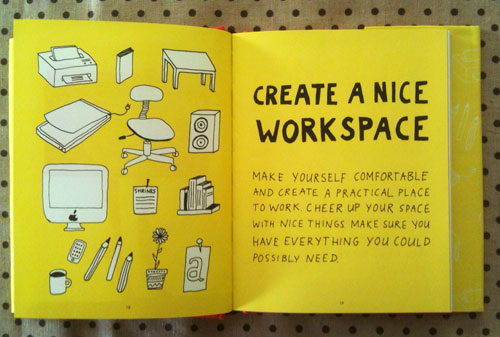
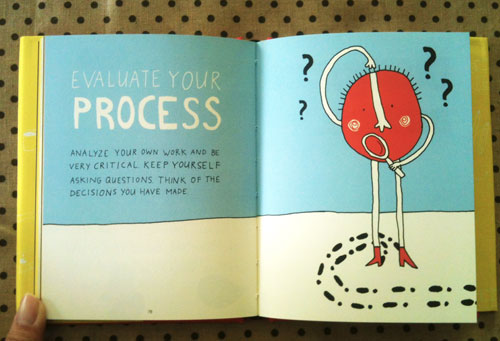
It almost feels as though she’s right there with you as a friend – giving you advice on how not to stress out, and reminds you to take a shower (who knew that running water increases productivity?) Her illustrations go well with the advice that she dispenses, and the spreads are almost like mini posters that you’d like to rip out and hang on your mirror (the book’s dust jacket also doubles as a poster!)
You can get your copy here (Amazon) or via BIS Publishers.
My apologies for the quality of the images, which were taken on my iPhone (3GS!) instead of a digital camera.