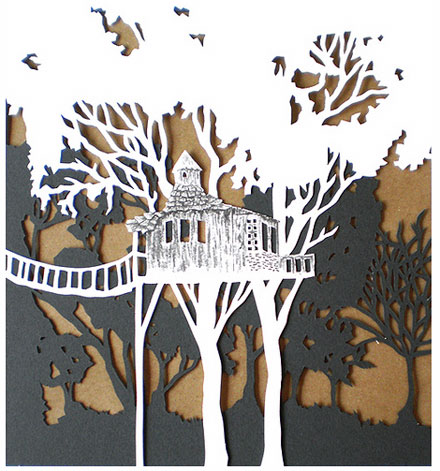
An artists’ progress is a work in motion. Case in point — fashion design student turned illustrator, and now papercut artist — Naomi Shiek is an inspiration on how artists evolve over time!

Name: Naomi Shiek
Location: Israel
Website/Shop: etsy.com/shop/thetimeisnow
Blog: woodland-papercuts.blogspot.com
Illustration media: papercutting
Tell us a little more about yourself!
I am 24 years old, and have been a freelance illustrator for the past year.
I was always fascinated by the creative arts. I remember I wanted to be an animator (which I ended up never attempting), a ceramic artist (which after a disastrous course I decided wasn’t for me), and eventually I set my sights on being a fashion design. After studying it for 4 years I became more and more attracted to print and textile design. I liked the idea of a 2D surface coming to life in 3D applications such as packaging, books, clothes and furniture. This wasn’t an easy decision for a 19 year old who had her life planned out to make. I ended up dropping what I was doing and starting over. Last year I graduated with a BA in graphic design. I’m still finding my feet.
Where do you live? What stands out about living where you are, and what is your daily schedule like?
I only moved to Tel-Aviv a month ago. First time I have an apartment all to myself, too. Tel-Aviv is different than any other city I’ve ever lived in. I live smack down at the center of it, where all the shops, movie theaters, and restaurants are, and I am over the moon with how close by everything is. I feel… so grown up! I don’t know if the city inspires me, as my work is decidedly woodland themed, but it definitely boosts up my spirits.
I work in a shop at a job that has absolutely nothing to do with art or design. It gives structure to my day, a time table to motivate me. I work on my illustrations at night (always was a night owl). It comes down to I have less time and more inclination to sketch, cut, create!
How did you get your start in illustration?
At the fashion college I attended they had a fashion illustration course. I only attended 2 or 3 classes, but I was hooked. I never thought I could draw, but here I was – drawing! I had already started buying all these graphic design books, looking at all the textile prints at shops, and I was pretty much gone. I didn’t really start “illustrating” until my first class at university. It was just illustrating different words using only circles, squares and triangles. Nothing big. I received such compliments on my work, though, that I remember thinking “ah, maybe this wasn’t such a mistake.” And I began drawing.
Could you tell us more about your thought process when you start a piece?
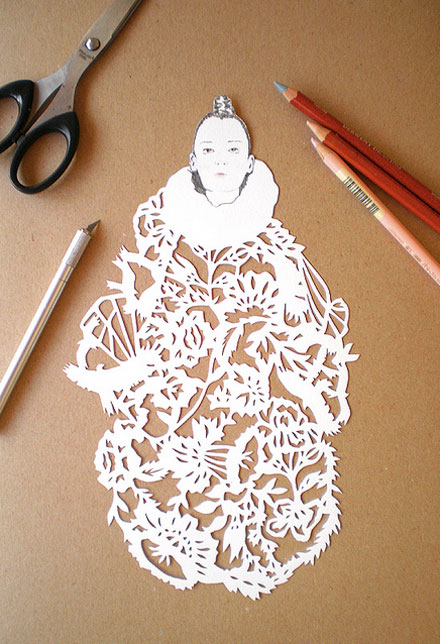
I’m very technical in my process. I always think about the materials I want to use first. What’s my subject, what is the message I want to communicate? I then start collecting visual elements to use in my design, before I start sketching the first layout. Sounds horrible, I know. I rarely do ‘off the cuff’ drawing. I think that’s why papercutting suits me so, it’s a method that requires patience and forethought.
How did you learn to cut like that?
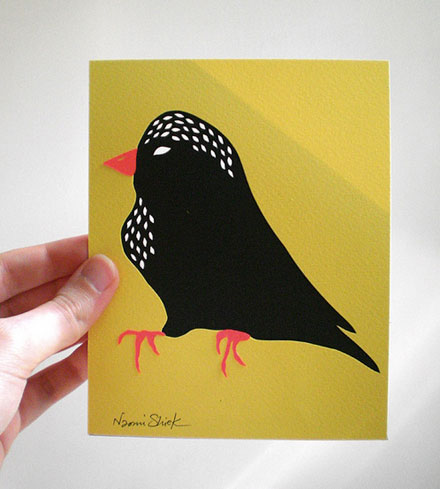
Practice. It’s a trial and error thing. First papercuts I made were these small wine labels for a course I took. I didn’t even have the right blade for it, just used something I had in my kit for years. They look so naive to me now. But that’s how I caught the bug. Fell in love with the Gestalt effect. After that I went to my supply shop, and bought different blades and different papers to experiment with. The more I cut the more I learned about what I could and couldn’t do, and what would make my designs more interesting. The rest is history. Here’s a tip, though: don’t try cutting circles, they never come out straight. Fluid, organic lines, though, work perfectly.

What’s your favorite project so far?
Hard to decide. My papercut book was the biggest project I’ve done yet. But I have to say I love all the custom papercuts I’ve done for clients. It makes me happy to create something unique for people who appreciate it. The most fun to do was a tattoo, though. I said I love tactile illustration and design, right? Well, it can hardly get more tactile than a tattoo!
Do you keep a journal/sketchbook, and would you mind if we had a sneak peek?
No, I don’t keep a sketchbook. I have a big cardboard folder filled with all the sketches and transfers of every papercut I’ve worked on, though. I often go back to them when working on a new piece. I also have a few papercuts I’ve done lying around that I never got to do anything with.
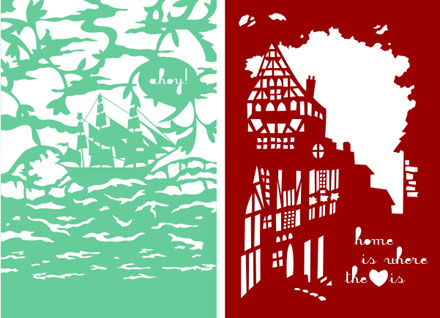
Would you care to share your studio space as well?
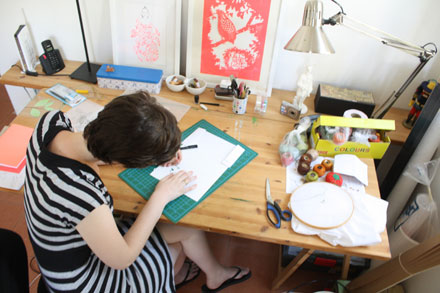
What or who inspires you?
My favorite style is art nouveau. The first artist who inspired me was Alfons Mucha. Ivan Bilibin’s illustrations are the optimum of art nouveau meets folklore for me.
Audrey Kawasaki is my favorite figurative artist! I can’t articulate how much she blows my mind. It probably doesn’t show, but I draw great inspiration from Jen Corace.
The papercut artist/designer/illustrator who first turned me unto papercutting – and who I strive to emulate in every way – he’s just so happy! – is Rob Ryan. You can’t beat Rob Ryan for words of wisdom and all-round optimism.
Could you share with us your progression as an artist — compared to when you first started out, how has your style changed since then?
Wow, when I first started out I wouldn’t even had attempted to draw anything. I didn’t know how to draw. I wanted to, so badly, but I was too afraid of failing. Yes, the curse of the perfectionist. But I made myself try. I started by drawing graphic shapes, then by attempting to master different painting techniques. When I think of how I couldn’t / wouldn’t try drawing a human body, to drawing models for my thesis project – I’m amazed by my progress. In 4 short years I painstakingly overcame my fear to draw, learned how to adapt my wishes with my abilities, to finally finding my own style! I will always credit my studies for giving me the courage to try and getting me where I am today. I never would have thought to try papercutting if it weren’t for my teacher Dovrat Ben-Nahum (http://www.cwctokyo.com/eng/artists/portfolio.cgi?ai=50) who opened my eyes to tactile illustration, who showed me that there are many ways to illustrate successfully, and that it’s ok to be different.
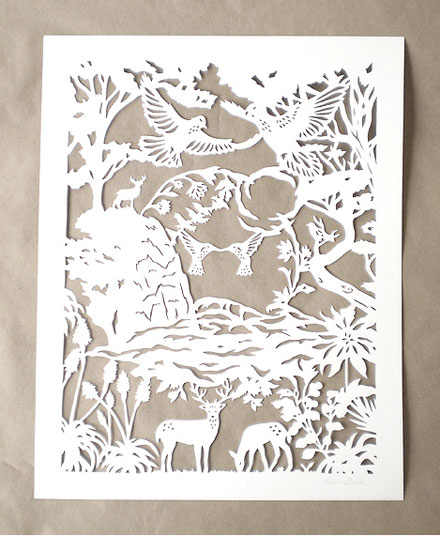
What advice would you like to give people who are interested in being an artist full-time?
I’m on my way there, I’d like to think, so I’ll give you the same advice I tell myself all the time: don’t be afraid! To do, to try, to step out of your comfort zone. I’m still walking the safe and narrow, but everyday I edge closer to taking the plunge. Full-time artist stories alway sound so… easy. But it always takes time, so do it your own way and at your own pace.
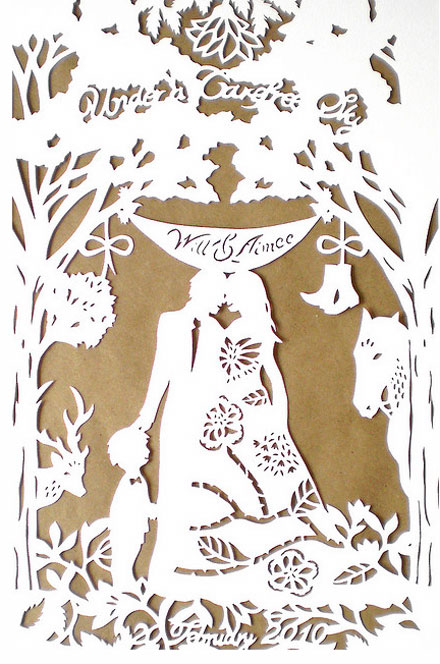
Where do you see yourself within the next few years?
If wishes were leaves, right? But here goes: a short few years down the line I see myself working (and playing), creating all day beautiful illustrations. I’ll make enough as an illustrator to support myself, and still have enough free time to pursue hobbies. Because right now all I do is collect ‘things-to-do’ and never get around to doing them.
What message do you want to send out to people about your work?
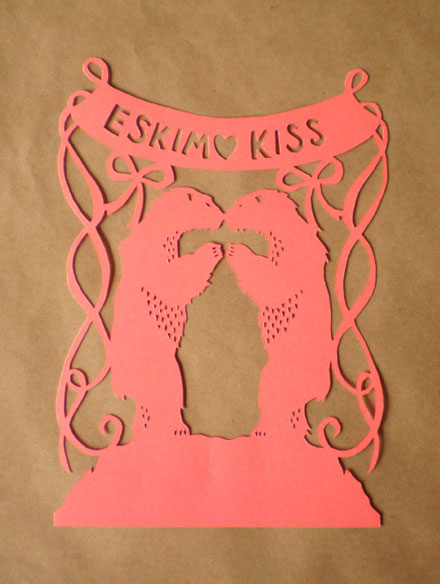
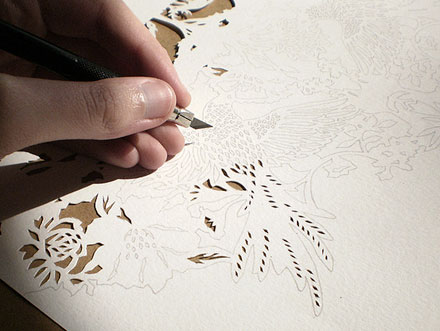
My papercuts are very much in the woodland theme, and I always try to insert something of the folk tales symbolism into my designs. All my work is entirely handmade. It’s a delicate and time consuming process, an art in and of itself, but I love it. What appeals most to me is the mystery of what you see, and the emergence of an image from a blank piece of paper. My papaercuts are simple, while at the same time highly detailed and intricate – it’s that contrast, done so subtly, that I love. I think papercuts bring back a bit of the old world romanticism into people’s lives. I certainly feel my papercuts do so for all the couples who contract me.